From “Old” World to “New” World: The Echoes of Europe in Canada’s Map
If you’ve ever looked at a map of Southern Ontario and felt a strange sense of déjà vu, you aren’t alone. From London (complete with its own Thames River) to Paris and Zurich, Canada’s geography—particularly in the south—reads like a “Greatest Hits” album of European geography.
While the UK’s place names are often rooted in Old English, Norse, or Roman origins dating back millennia, Canada’s toponymy is a layered cake of colonial ambition, indigenous heritage, and a healthy dose of “I miss my hometown.”
The “Home Away From Home” Names
The most obvious link to the UK is the direct transplanting of names. When British settlers arrived, they didn’t just bring their tea and law; they brought their maps. This was a deliberate attempt by 18th and 19th-century administrators to make the dense, intimidating forests of the “New World” feel structured and familiar.
- York (Toronto): Before it was Toronto, it was “York,” named after the Duke of York. While the city eventually reclaimed its indigenous name, the surrounding regions (North York, East York) keep the English spirit alive.
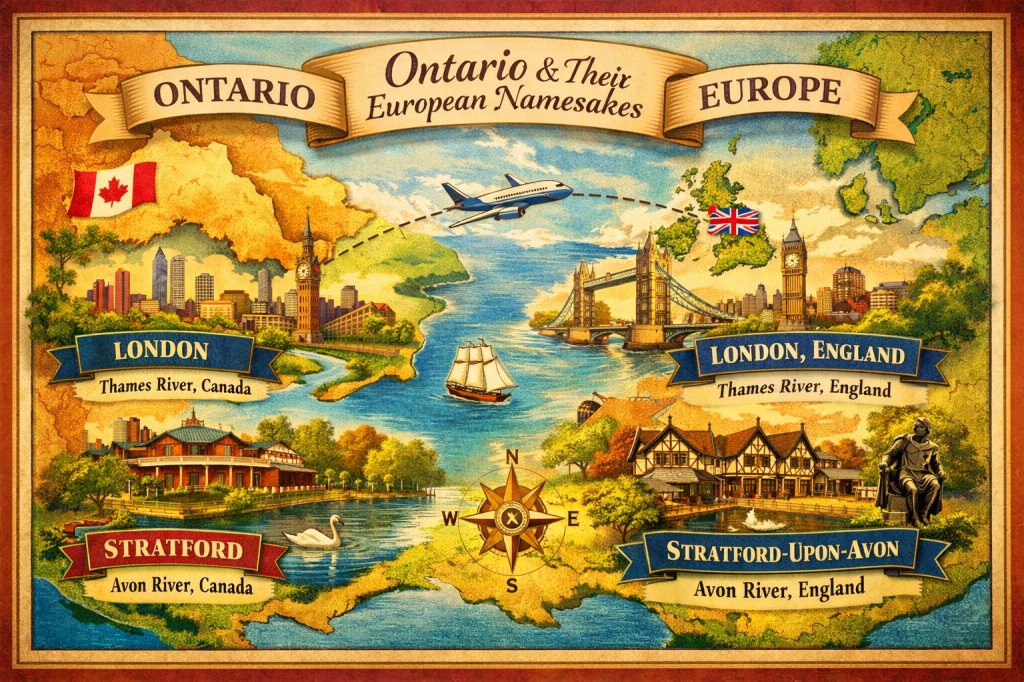
- Stratford, Ontario: Just like its UK counterpart, it sits on an Avon River and is famous for its Shakespearean theater.
- The Imperial Shortcut: John Graves Simcoe, the first Lieutenant Governor of Upper Canada, was obsessed with recreating British society. He named London, Ontario, intending for it to be the capital, and renamed the local river the Thames to mirror the geography of England’s capital.
- New Brunswick & Nova Scotia: Even the provinces reflect this. Nova Scotia is literally Latin for “New Scotland,” while New Brunswick was named in honor of King George III, who was also the Duke of Brunswick.
A Tour of “Ontario-Europe”
Because of the massive waves of immigration from across the Atlantic, you can practically travel across Europe without ever leaving the 401 corridor.
| Ontario Town | European Namesake | Context |
| Paris | Paris, France | Named for the nearby plaster of Paris (gypsum) deposits. |
| Berlin | Berlin, Germany | Now known as Kitchener; the name was changed during WWI. |
| Brussels | Brussels, Belgium | Named in 1872 to honor the Belgian capital. |
| Waterloo | Waterloo, Belgium | Named to commemorate the 1815 defeat of Napoleon. |
| Sarnia | Isle of Guernsey | “Sarnia” is actually the Latin name for the Isle of Guernsey. |
The Royal Treatment & Linguistic Tug-of-War
In the UK, you’ll find endless “Regent” streets and “King’s” crosses. In Canada, we took it a step further by naming entire provinces and cities after the reigning monarchs or their families. Victoria, BC, and Regina, Saskatchewan (Latin for “Queen”), both honor Queen Victoria.
However, Canada’s map is also a hybrid. Many names are anglicized versions of Indigenous words, creating a unique linguistic blend:
- Ottawa: From the Algonquin Odawa, meaning “to trade.”
- Quebec: From Kébec, meaning “where the river narrows.”
- Saskatoon: Named after Mis-sask-quah-toomina, a local violet-colored berry.
Why So Many European Names?
There were three main drivers for this “Europeanization” of the local map:
- Nostalgia and Marketing: Land companies knew settlers were more likely to buy land in a place called “Cambridge” than a numbered lot. It promised a level of culture that hadn’t been built yet.
- Military Connection: Many towns were named after famous battles or generals to instill a sense of British loyalty.
- Linguistic Safety: For British authorities, replacing Indigenous names with European ones was a way of asserting “ownership” and making the land legible for the British legal and postal systems.
The Accidental & The Odd
Just as the UK has “Llanfairpwllgwyngyll…” and “Ham,” Canada has its own quirks born from the chaos of early settlement.
- Dildo, Newfoundland: While it sounds like a modern prank, the name likely dates back to the 17th century and may refer to a part of a rowboat (a thole pin) or simply be a phonetic evolution of a Spanish or Portuguese word.
- Saint-Louis-du-Ha! Ha!: Located in Quebec, this is the only town in the world with two exclamation marks. The “Ha! Ha!” is an archaic French word for an unexpected obstacle or dead end.
The Shared DNA of the Map
Whether it’s a village in the Cotswolds or a hamlet in the Canadian Prairies, place names are more than just labels; they are time capsules. They tell us who was in charge, what they were proud of, and what they missed most about the homes they left behind. Canada’s map is a permanent conversation between its original inhabitants and the settlers who tried to make a vast landscape feel a little more like a cozy village in Yorkshire or a bustling street in Lisbon.
 Canadian Country Life
Leave a comment