
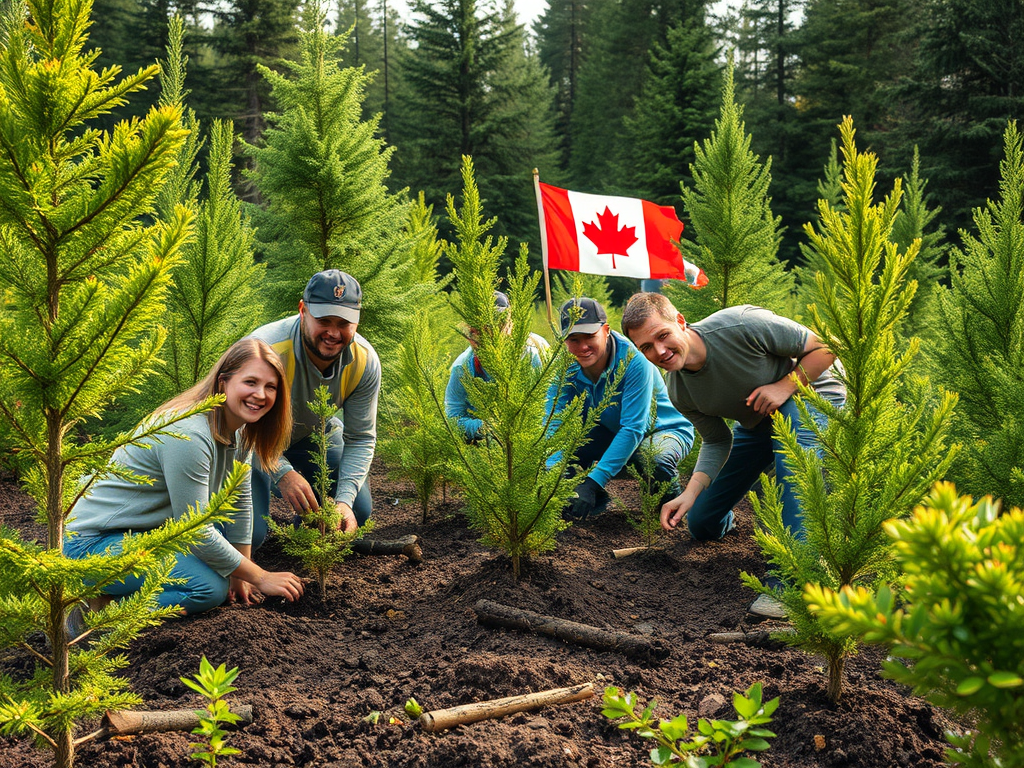
Rooting for the Future: A Guide to Canada’s Government Tree Planting Programs
Across the Great White North, the landscape is changing—one seedling at a time. Whether you’re a rural landowner in Ontario, a municipality in the Prairies, or an Indigenous community in the North, there are robust government-backed initiatives designed to help you green your neck of the woods.
As we move through 2026, the landscape of these programs has shifted. While some federal “mega-programs” are evolving, local and provincial opportunities are branching out more than ever. Here is how these programs work and where you can find them.
1. The Federal Powerhouse: 2 Billion Trees (2BT)
The 2 Billion Trees program, led by Natural Resources Canada, has been the flagship of federal planting efforts. Its goal is simple but massive: to plant two billion trees by 2031 to capture carbon and boost biodiversity.
- How it works: This program typically doesn’t give a single tree to a single person. Instead, it funds large-scale partnerships. It works with provinces, territories, and non-profits to get mass amounts of “seedlings in the ground.”
- Current Status (2026): While the program has begun winding down new direct applications for certain streams, it continues to honor existing long-term agreements. Much of its current impact is now seen through partner organizations like Tree Canada and Forests Canada.
2. Municipal Support: Growing Canada’s Community Canopies (GCCC)
For those in urban areas, the Green Municipal Fund (GMF), through the Federation of Canadian Municipalities, is the primary driver.
- The Goal: To expand the urban forest, reduce “heat islands” (where city pavement makes things too hot), and manage stormwater.
- Who can apply: Municipalities and groups partnering with local governments.
- The Perks: These programs often cover up to 50% of project costs, including the price of the trees, the labor to plant them, and even the “capacity building” (hiring staff to manage the project).
3. Provincial & Regional Stars
Most “boots on the ground” planting happens through provincial agencies and local conservation authorities. These programs are often the most accessible for private citizens.
| Program | Region | Focus |
| 50 Million Tree Program | Ontario | Managed by Forests Canada, it helps landowners with at least 0.5 acres (or space for 500+ trees) significantly reduce planting costs. |
| PEI 2 Billion Trees | Prince Edward Island | Focuses on retired farmland and riparian (riverside) zones. They often provide the trees and the planting services for free to eligible landowners. |
| SNC Tree Planting | Eastern Ontario | Organizations like South Nation Conservation provide “full-service” planting, with seedlings often discounted to as little as $1.11 to $1.68. |
| ALUS Canada | Rural/Agricultural | Partners with the federal government to help farmers turn “marginal” (unproductive) land into forest or pollinator habitat. |
How These Programs Actually Work
Most people assume you just get a bag of seeds in the mail, but it’s a much more professional process:
- Site Assessment: A forestry professional or “planting partner” visits your land to check soil quality, drainage, and sun exposure.
- The “Right Tree, Right Place” Plan: They won’t just plant anything. They select native or climate-resilient species that will actually survive in your specific region.
- Cost-Sharing: Depending on the program, the government might pay for 50% to 90% of the costs. In some cases, like Indigenous-led projects or certain provincial initiatives, 100% of the cost is covered.
- Survival Monitoring: Most programs require a “survival assessment” at the 2-year and 5-year marks. If the trees die, they want to know why—and they may even help you replant.
Pro Tip: Many programs for Spring 2026 planting have deadlines in late 2025 or early January. If you’re looking to plant, autumn is the best time to start your application.
Ready to get growing?
If you’re a landowner or part of a community group, the first step is usually a “readiness check.”
In Southern Ontario, tree planting programs are primarily delivered through Conservation Authorities (CAs). Since you are in Sarnia, your local point of contact is the St. Clair Region Conservation Authority (SCRCA), though several other authorities in the region offer excellent subsidies for rural landowners.
Here is the breakdown of the most relevant programs for your area as of February 2026.
1. Local Contact: St. Clair Region Conservation Authority (SCRCA)
If your property is in the Sarnia/St. Clair watershed, this is your primary agency for technical advice and subsidized seedlings.
- How it works: They offer a Seedling Program for smaller rural projects and a Full-Service Program for larger reforestation (minimum 500 trees).
- Costs: Seedlings typically cost between $0.70 and $1.50 each, depending on the species and quantity.
- Deadline: Orders for Spring 2026 typically need to be finalized by late March 2026, but it is highly recommended to contact them now as popular native species (like White Pine or Red Oak) sell out early.
- Contact: Call Jeff Sharp, Conservation Services Technician, at 519-245-3710 ext. 217.
2. The 50 Million Tree Program (Forests Ontario)
This is the most popular program for Southern Ontario landowners who want to plant on a larger scale (at least 0.5 hectares or roughly 1.25 acres).
- The Subsidy: This program can cover up to 75% to 90% of the total cost of the project, including the site visit, the planting plan, the trees, and the labor.
- The Commitment: You must agree to protect the trees for at least 15 years.
- How to Apply: You don’t apply to the government directly; you apply through a Planting Delivery Agent (PDA). In Southern Ontario, your PDA is usually your local Conservation Authority (like SCRCA) or a private forestry consultant.
3. Neighboring Programs (If you have land further East/South)
If your land falls outside the St. Clair watershed, these authorities offer similar robust programs:
| Authority | Key Feature | Contact Info |
| Upper Thames River (UTRCA) | High subsidies for windbreaks and “fragile land” retirement. | 519-451-2800 ext. 243 |
| Lower Thames Valley (LTVCA) | Focuses on the Chatham-Kent area; offers 50%–75% cost-sharing. | yournature@lowerthamesfoundation.ca |
| Maitland Valley (MVCA) | Offers specific grants for “Resilient Agricultural Landscapes.” | 519-335-3557 ext. 250 |
4. Tips for Landowners in 2026
- Site Preparation is Key: If you are planning a Spring 2026 planting, the “site prep” (mowing or spraying to reduce competition from grass) should ideally begin as soon as the ground thaws.
- Species Selection: Southern Ontario is currently focusing heavily on Oak Wilt resistance and climate-resilient species. Ask your technician about “Assisted Migration” trials if you want trees that are better suited for the warmer summers we’ve been seeing lately.
- Tax Benefits: Successfully planting a large enough area (usually 4 hectares or more) may qualify your property for the Managed Forest Tax Incentive Program (MFTIP), which can reduce your property taxes by up to 75%.
Important Update: The Federal 2 Billion Trees program has officially stopped accepting new direct applications as of late 2025. However, they are still funding the programs listed above through Forests Ontario, so applying locally is now the only way to access those federal funds.
 Canadian Country Life
Leave a comment