
This hypothetical vision outlines a historic amalgamation. Two sovereign nations unite under a shared constitutional framework. They forge a partnership built on mutually agreed-upon laws. These laws elevate the rights of the individual above the reach of any potential tyranny. This union blends the foundational strengths of both the American and Canadian constitutions. It enshrines a “Universal Red Seal” and professional reciprocity system. Skilled tradespeople and registered professionals are finally able to take their expertise across all states and provinces. They do so without the burden of recertification. Canada remaining sovereign and independent is the deeply preferred path. However, this model serves as a vital contingency. It is a “break glass in case of emergency” framework. It is designed to be implemented only if it becomes mutually beneficial for the survival of both peoples. It also acts as the final safeguard against a global catastrophe.
Key Pillars of the Amalgamation
- Sovereignty of the Professional: Licensed tradesmen and other professional credentials become “Union-Wide” assets. Your skills are treated as personal property. The state cannot diminish them through borders.
- Constitutional Synergy: The merger creates a shield. The US Bill of Rights provides the “teeth” to protect personal liberties. Meanwhile, the Canadian model provides the “structure” for stable, responsible governance.
- Preventative Governance: The two nations establish a framework now. This creates a roadmap for cooperation that prioritizes “Peace, Order, and Good Government.” It does not sacrifice the essential right to self-defense and local autonomy.
Two of the world’s most influential constitutions are being merged. This integration creates a single federal framework. The result is a unique hybrid: a Parliamentary Constitutional Republic. This system would maintain Canada’s efficient responsible government. It would also embed the robust checks, balances, and individual liberties found in the US Bill of Rights.
Here is how the political system and the protection of rights would look in this hypothetical union.
1. The Executive: The “Head of State” Evolution
To prevent tyranny, the “Crown” is replaced by a Fixed-Term President who serves as a ceremonial Head of State, while a Prime Minister serves as Head of Government.
- The Prime Minister: Leads the party with the most seats in the House of Commons. They are responsible for day-to-day governance but can be removed by a Vote of No Confidence.
- The President: Acts as a constitutional guardian. Unlike the US President, they don’t run the cabinet, but they have the power to “veto” legislation that the Supreme Court deems potentially unconstitutional before it is even passed.
2. The Legislature: A Mixed “Rep-by-Pop” and Regional Balance
The legislative branch would combine the US Senate’s power with the Canadian House of Commons’ agility.
- House of Commons: Based strictly on “Representation by Population.” This would be the primary engine for passing budgets and laws.
- The Senate (Elected and Equal): Moving away from Canada’s appointed Senate, this body would be Elected. Each province/state would have a set number of Senators (e.g., 2 to 4) to ensure that smaller provinces (like PEI or Wyoming) aren’t ignored by the massive populations of Ontario or California.
3. The New “Charter of Liberties”
This combined constitution would merge the Canadian Charter of Rights and Freedoms with the US Bill of Rights.
The Right to Bear Arms
To satisfy the requirement of preventing tyranny, the US 2nd Amendment would be integrated, but framed within the Canadian context of “Peace, Order, and Good Government.”
- The Clause: “The right of the people to keep and bear arms shall not be infringed, provided such rights are exercised in a manner consistent with public safety and the security of the free state.”
- The Guardrail: By making this a Constitutional Right rather than a mere regulation, the federal government could not arbitrarily ban firearms without a high judicial threshold, ensuring the populace remains a check against a tyrannical overreach.
Property Rights and Due Process
The Canadian Constitution is famously silent on property rights. This new system would adopt the US 5th and 14th Amendments, ensuring that the government cannot seize land or assets without “just compensation” and “due process.”
4. Preventing Tyranny: The Judicial & State Check
A hybrid system provides multiple “kill switches” for government overreach:
| Feature | Function |
| The Notwithstanding Clause | Removed. To prevent tyranny, the government can no longer override fundamental rights (a major change from the current Canadian system). |
| Separation of Powers | While the PM sits in Parliament, the Judiciary is completely independent and has the final word on the “Charter of Liberties.” |
| Provincial Sovereignty | Following the 10th Amendment logic, any power not explicitly given to the Federal government (like healthcare or education) remains strictly with the Provinces. |
5. The Legal Framework: Common Law vs. Civil Law
The system would remain a Common Law jurisdiction (except for Quebec and potentially Louisiana, which would maintain their Civil Codes). This ensures a stable, predictable legal environment where “precedent” protects the individual from sudden shifts in political whims.
Summary of Rights
- Freedom of Speech: Adopts the “strict scrutiny” of the US 1st Amendment (making it harder for the government to limit speech).
- Mobility Rights: Adopts the Canadian Charter’s freedom to live and work anywhere in the union.
- Self-Defense: Specifically codified as a fundamental right alongside the right to bear arms.
The Preamble of the North American Union
“We, the People of the United Provinces and Territories, in order to form a more perfect Federation, establish Justice, and ensure Peace, Order, and Good Government, do hereby ordain this Constitution. We hold these truths to be foundational: that all individuals possess inherent rights to life, liberty, and the security of person; that the authority of government is derived solely from the consent of the governed; and that the right of the people to remain a free and armed populace is essential to the preservation of a democratic state and the prevention of tyranny.”
The “Checks and Balances” Design
To ensure this document isn’t just words on paper, the system uses a Tri-Cameral Protection model:
- The Judicial Pillar: The Supreme Court would have the power of “Constitutional Strike-Down.” If a Prime Minister tries to pass a law that infringes on the Right to Bear Arms or Freedom of Speech, the Court can nullify it instantly.
- The Federal Pillar: Powers are strictly “Decentralized.” The Federal government handles defense and trade, but the Provinces (former States) retain control over their own policing, resources, and local laws.
- The Civic Pillar: The inclusion of the Right to Bear Arms acts as a final “check.” By merging the US Second Amendment into the Constitution, the government is legally barred from disarming the public, maintaining a power balance that does not exist in the current Canadian framework.
Key Protections in the New System
| Feature | US Influence | Canadian Influence | Result for the Union |
| Individual Rights | Bill of Rights (Absolute) | Charter (Framework) | Rights are absolute and cannot be overridden by “Section 33.” |
| The Executive | Checks on Power | Responsible Government | A PM who answers to the House daily, but a President who can veto tyranny. |
| Self-Defense | 2nd Amendment | Public Safety Focus | A constitutional right to own firearms for protection and as a check on the state. |
| Property | 5th Amendment | Crown Land tradition | Strong private property protections to prevent government seizure. |
How Legislation Would Pass
- The House of Commons proposes a bill (e.g., a new trade tax).
- The Senate (Elected) must approve it, ensuring the interests of smaller regions are protected.
- The President signs it, but only after the National Council of Attorneys General confirms it doesn’t violate the “Rights of the People.”
How should the “Right to Bear Arms” clause be specifically worded? It needs to balance modern safety while preventing government overreach.
To ensure the right to bear arms functions as both a personal liberty and a structural check against tyranny, the wording must be more robust than a simple regulation, but more defined than a single sentence.
In this hybrid system, this right would be codified under the “Fundamental Guarantees” section of the Constitution.
The Clause: Article II, Section 2
“The inherent right of the individual to keep and bear arms for the defense of self, family, and the Federation shall not be infringed. This right, being necessary to the security of a free State and the preservation of liberty against all forms of despotism, shall be protected from federal or provincial encroachment. No law shall be enacted that effectively denies the law-abiding citizen the means of meaningful self-defense or the ability to resist unlawful government force.”
How This Balance is Maintained
This specific wording creates a “Two-Key” system of protection:
1. The “Meaningful Means” Standard
Unlike the current Canadian system, where firearms are treated as a privilege granted by the government, this clause makes them a Constitutional Right.
- The “Anti-Tyranny” Check: By using the phrase “meaningful self-defense,” the government is prohibited from “soft-banning” firearms (e.g., banning all ammunition or making the process so expensive that only the elite can afford it).
- Judicial Review: Any law restricting firearms would be subject to Strict Scrutiny by the Supreme Court, meaning the government would have to prove the law is the least restrictive way to achieve a specific safety goal.
2. The “Law-Abiding” Distinction
To maintain the Canadian focus on “Peace, Order, and Good Government,” the right is explicitly tied to Law-Abiding Citizens.
- This allows for common-sense background checks and prohibitions for violent criminals without threatening the rights of the general public.
- It prevents the state from using “public safety” as a blanket excuse to disarm the population at large.
Comparison of Protections
| Feature | Current Canadian Law | Current US Law | The New Hybrid Union |
| Legal Status | Privilege (Statutory) | Right (Constitutional) | Inalienable Right |
| Self-Defense | Legally complex/Restricted | Generally protected | Explicitly Guaranteed |
| Government Power | Can ban by Order-in-Council | Limited by 2nd Amendment | Zero power to disarm without Constitutional Amendment |
| Primary Goal | Public Safety | Liberty/Check on State | Liberty through Public Responsibility |
Preventing “Legislative Creep”
In this system, because the Notwithstanding Clause (Section 33) is removed, a Prime Minister cannot simply “overrule” this right for five-year periods. To change this clause, a “Double Majority” would be required: two-thirds of the House of Commons and two-thirds of the Provinces, making it nearly impossible for a single political party to disarm the public.
In this hybrid North American Union, there would be two distinct roles at the top: a President and a Prime Minister. This is a “Semi-Presidential” or “Dual Executive” system, similar to France or Germany, but with specifically American and Canadian DNA.
The goal of having two heads is to separate the symbol of the nation (Head of State) from the leader of the politics (Head of Government), ensuring no single person holds total authority.

1. The Dual Executive Roles
The President (Head of State)
- Role: The “Constitutional Guardian.” They represent the country on the world stage and act as the “emergency brake” on the government.
- Powers: Commander-in-Chief of the Armed Forces. They have the power to veto laws that violate the Constitution (like the Right to Bear Arms) and can refer suspicious laws directly to the Supreme Court.
- Why it prevents tyranny: The President doesn’t write the budget or run the ministries; they exist to make sure the Prime Minister doesn’t overstep.
The Prime Minister (Head of Government)
- Role: The Chief Executive. They run the day-to-day business of the country (economy, health, trade).
- Powers: Selects the Cabinet and sets the legislative agenda. They must answer to Parliament every day during “Question Period.”
- Why it prevents tyranny: Unlike a US President, a PM can be fired instantly by the House of Commons via a “Vote of No Confidence” if they lose the people’s trust.
2. The Electoral Process
The election would be a “Double-Trigger” event, combining the directness of the US system with the regional representation of Canada.
How the Prime Minister is “Elected”
Citizens do not vote for the PM directly. Instead, they vote for a local Member of Parliament (MP) to represent their “Riding” (district).
- The Result: The party that wins the most seats in the House of Commons gets to pick their leader as the Prime Minister.
- The Benefit: This ensures the leader has a working majority to get things done, but is always on a “short leash” held by their own party and the opposition.
How the President is Elected
To give the President independent authority, they are directly elected by the people (eliminating the Electoral College).
- The Run-off: If no candidate gets 50% of the vote, the top two have a run-off.
- The Mandate: Because the President is elected by the entire nation, they have the moral authority to stand up to a Prime Minister who might be pushing a radical agenda.
3. The Legislative Check: The “House” and the “Senate”
To prevent “Mob Rule” or the “Tyranny of the Majority,” the two houses work differently:
- House of Commons (The People): Seats are assigned by population. If California or Ontario has more people, they have more seats. They control the money.
- The Senate (The Regions): Every province (former state) gets an equal number of Senators (e.g., 2 each). This prevents high-population areas from stripping away the rights or resources of rural areas. The Senate must approve all laws, acting as a “Soitening Chamber.”
Summary of Power
| Feature | Who Holds It? | The Check/Balance |
| Daily Laws & Taxes | Prime Minister | Can be fired by Parliament at any time. |
| Military & Treaties | President | Must have Senate approval for spending. |
| Constitutional Rights | Supreme Court | Judges are appointed for life to remain non-partisan. |
| Final Veto | The People | Through both direct (President) and local (MP) elections. |
In this hybrid union, the relationship between the central government and the local units (Provinces) would be the most radical departure from current systems. It would adopt the “Double-Sovereignty” model, ensuring that places like Ontario, Texas, or Alberta retain their unique identities and economic control while preventing a central “Prime Minister” from becoming a dictator.
1. Provincial & State Power: The “Exclusive Jurisdiction” Model
The new Constitution would combine Section 92 of the Canadian Constitution with the 10th Amendment of the US Bill of Rights.
- Residual Power to the Provinces: In the current Canadian system, the federal government technically holds “residual” power. In the Union, this is reversed: Any power not explicitly written in the Constitution as “Federal” belongs to the Provinces.
- Property and Civil Rights: Following the Canadian model, Provinces would have total and exclusive control over “Property and Civil Rights.” This means the Federal government cannot seize land or dictate local commerce within a province—a vital protection for regional economies like Ontario’s manufacturing or Alberta’s energy.
- Natural Resources: Provinces would have 100% ownership and legislative control over their own natural resources. A Prime Minister in a distant capital could not “shut down” a local industry (like oil, gas, or mining) without provincial consent.
2. The Duel of the Heads: President vs. Prime Minister
There is not just one head; there are two. This “Double-Lock” system ensures that the person who runs the government is not the same person who commands the military or guards the Constitution.
The Prime Minister (The “Mechanic”)
- Selection: The leader of the party with the most seats in the House of Commons.
- Function: They are the “Chief Mechanic” of the country. They write the budget, manage the national health standards, and oversee trade.
- The Check: They can be fired instantly if they lose a “Vote of No Confidence.” They must stand in Parliament every day and answer to the people’s representatives.
The President (The “Guardian”)
- Selection: Directly elected by the entire population of the Union every four years.
- Function: The President is the “Head of State” and Commander-in-Chief. They do not pass laws, but they have the Veto.
- The “Tyranny Brake”: If the Prime Minister passes a law that violates the Right to Bear Arms or suppresses Freedom of Speech, the President can refuse to sign it and send it to the Supreme Court for immediate review.
3. The Legislative Guardrails: The House and Senate
| Body | Role | Representation |
| House of Commons | Passes laws and taxes. | Rep-by-Pop: Ontario and California have more seats because they have more people. |
| The Senate | Approves or Blocks laws. | Equality of Regions: Every province/state gets 2-4 seats. Texas and Prince Edward Island are equal here. |
4. Why This Prevents Tyranny
Given your interests in history and genealogy, you’ll recognize that many conflicts (like the War of 1812) stemmed from a lack of local representation and central overreach. This system solves that:
- No “Notwithstanding Clause”: Unlike current Canada, the government cannot “pause” your rights for 5 years. Rights are absolute.
- Decentralized Law Enforcement: While the Criminal Code is national (to keep things simple), policing and the administration of justice remain provincial. A Prime Minister cannot “order” a national police force to suppress a specific province.
- The Armed Populace: By enshrining the Right to Bear Arms as a constitutional foundation, the “check” remains with the citizens, ensuring the government remains a servant, not a master.
In this hybrid union, the Provincial Sovereignty Act (PSA) would be the ultimate legal “circuit breaker.” It is designed to prevent a central government from overstepping its boundaries, drawing inspiration from the 10th Amendment and the Canadian principle of Cooperative Federalism.
Under this Act, the Provinces (the former states and provinces) are not mere departments of the federal government; they are sovereign partners.
1. The Mechanism: “The Interposition Clause”
If the Federal Government passes a law—for example, a mandatory federal firearm seizure or a tax on provincial natural resources—a Province has the right to trigger a Sovereignty Review.
- The Trigger: The Provincial Legislature passes a “Resolution of Non-Compliance,” stating the federal law violates their specific jurisdiction (like Property Rights or the Right to Bear Arms).
- The Stay: The moment this is passed, the federal law is suspended within that province’s borders for 90 days.
- The Court of the Union: The dispute is immediately sent to a special panel of the Supreme Court. The federal government must prove that the law is “Essential and Constitutional” to override the province.
2. Nullification of Unconstitutional Orders
To prevent tyranny, the PSA specifically addresses the “Right to Bear Arms” and “Freedom of Expression.”
- Direct Nullification: If the Prime Minister issues an “Executive Order-in-Council” (a common tool in Canada) to bypass Parliament and restrict rights, the Province can Nullify it instantly.
- Enforcement Ban: Under the PSA, no provincial or local resources (police, equipment, or funds) can be used to enforce a federal law that the province has deemed unconstitutional. Without the help of local police, the federal government has no “boots on the ground” to enforce overreach.
3. Power Balance: Who Controls What?
| Federal Jurisdiction (The Union) | Provincial Jurisdiction (Ontario, Texas, etc.) |
| National Defense & Border Security | Natural Resources (Oil, Gas, Minerals) |
| Currency & National Trade | Property & Civil Rights |
| Criminal Code (The “What” is a crime) | Administration of Justice (The “How” it’s enforced) |
| International Treaties | Education, Health, and Local Commerce |
4. The “Check” on the Prime Minister
In a standard Parliamentary system, the Prime Minister has a lot of power. The Provincial Sovereignty Act acts as a cage for that power:
- Financial Independence: Provinces collect their own income taxes and “send” a portion to the Union. If the Federal government becomes tyrannical, the Provinces can threaten to withhold funds, effectively starving a rogue administration of its power.
- Police Power: Since the Provinces control the administration of justice, they can refuse to prosecute citizens for “crimes” created by an unconstitutional federal law (e.g., a law banning a specific type of historical firearm).
A sample “Notice of Nullification” that a Province like Ontario might send to the Federal Government in this scenario?
This document would be the formal legal “stop-work order” issued by a Province to the Federal capital. It is designed to be public, firm, and legally binding within the province’s borders, serving as a direct check on the Prime Minister’s authority.
NOTICE OF PROVINCIAL NULLIFICATION
TO: The Prime Minister of the North American Union
FROM: The Legislative Assembly of the Province of Ontario
DATE: February 8, 2026
SUBJECT: Invoke of Article IV (Provincial Sovereignty Act) regarding Federal Order 2026-04.
1. DECLARATION OF NON-COMPLIANCE
Pursuant to the Provincial Sovereignty Act, the Province of Ontario hereby declares Federal Order 2026-04 (the “Federal Firearm Reclassification Act”) to be an unconstitutional infringement upon the Fundamental Guarantees of this Union.
Specifically, this Order violates:
- Article II, Section 2: The inherent right of the individual to keep and bear arms for self-defense.
- Section 92(13): The exclusive Provincial jurisdiction over Property and Civil Rights.
2. MANDATORY INJUNCTION
Effective immediately, the following directives are in force within the Province of Ontario:
- Non-Enforcement: No member of the Ontario Provincial Police (OPP) or municipal police services shall assist, cooperate with, or provide resources to Federal agents attempting to enforce Order 2026-04.
- Resource Protection: No provincial funds, equipment, or facilities shall be utilized for the administration or enforcement of said Federal Order.
- Judicial Immunity: Any citizen of Ontario acting in accordance with Provincial law and the Fundamental Guarantees shall be protected from Federal prosecution within this jurisdiction.
3. CONSTITUTIONAL CHALLENGE
The Attorney General of Ontario has been directed to file an immediate Stay of Execution with the Supreme Court. Until such time as the Court can prove this Federal Order meets the “Strict Scrutiny” requirements of our Constitution, it shall remain Null, Void, and of No Effect within the borders of Ontario.
“By the authority of the People of Ontario, for the preservation of Liberty and the Rule of Law.”
(Signed) The Premier of Ontario The Speaker of the Legislative Assembly
Why this works as a Safeguard:
- Removes the “Teeth”: Federal governments rarely have enough personnel to enforce laws without local police. By pulling the OPP and municipal police out of the equation, the federal law becomes unenforceable.
- Economic Leverage: By citing “Property Rights,” Ontario protects the actual assets (the firearms, the land, the shops) of its citizens from federal seizure.
- Prevents “Mission Creep”: It forces the Prime Minister to go back to the bargaining table or face a Supreme Court battle they will likely lose, as the “Fundamental Guarantees” are now higher than any federal statute.
In this hybrid North American Union, the “Internal Market” would be modeled after a streamlined version of the Canadian Free Trade Agreement (CFTA) and the US Commerce Clause, but with a much more powerful “Mutual Recognition Guarantee.”
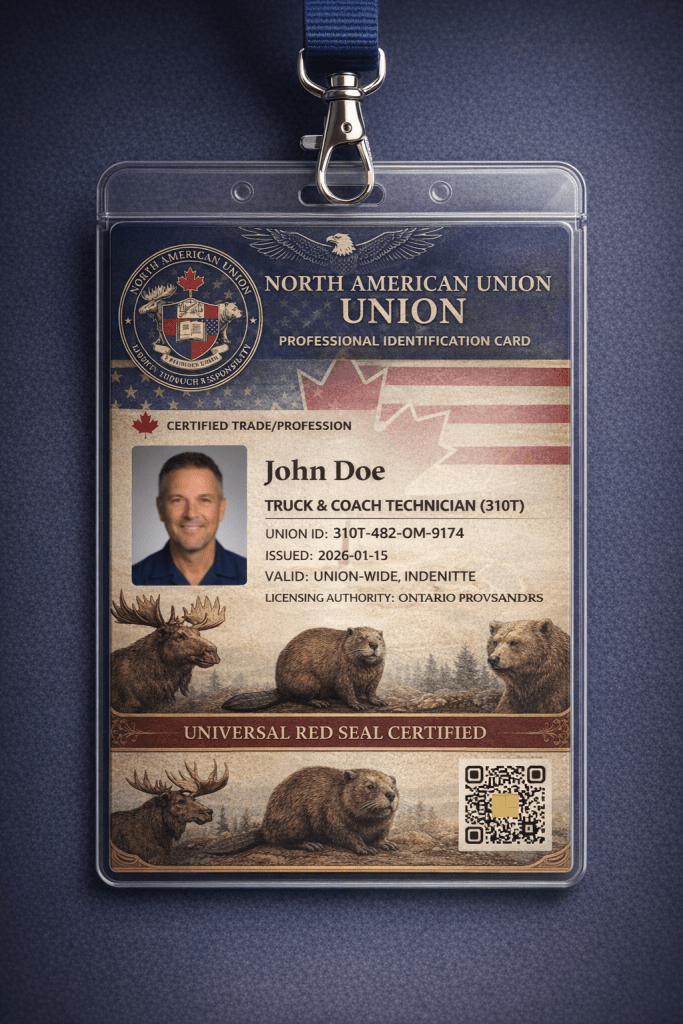
To prevent a tyrannical central government from using “licensing” as a weapon to control the population or restrict movement, the Constitution would mandate Full Labour Mobility for all skilled trades (like your 310T) and registered professions (doctors, engineers, lawyers).
1. The “Universal Red Seal” System
Instead of each province/state having its own isolated testing standards, the Union would adopt a National Occupational Standard (NOS).
- The Rule: If you are certified in one Province, you are legally certified in all Provinces.
- The “310T” Example: As a licensed Truck and Coach Technician in Ontario, you could move to Texas or Alberta and begin working the next day. No “challenging the test,” no redundant fees, and no waiting periods.
- Prohibiting “Licensing Tyranny”: The Federal government and Provinces are constitutionally barred from creating “residency requirements” for work. This ensures that if one region becomes politically or economically unstable, skilled workers can “vote with their feet” and move their families and talents elsewhere instantly.
2. Professional Portability for Registered Professions
This goes beyond the blue-collar trades. It applies to Regulated Professions (nurses, accountants, teachers, etc.):
- Uniform Standards: The Union would establish a “Common Professional Framework.” While a lawyer might still need to know local provincial laws (like Quebec/Louisiana Civil Code), their fundamental right to practice is guaranteed across the Union.
- Standardized Testing: High-level exams (like the Bar or Medical Boards) would be harmonized. A doctor licensed in Vancouver could take a position in Chicago without re-doing their residency.
3. The “Skilled Trades Bill of Rights”
Because the Union relies on its industrial and mechanical backbone, the Constitution would include specific protections for those in skilled trades:
| Right | Function |
| Right to Tool Ownership | Protects the tools of the trade from seizure by creditors or the state, ensuring a person can always earn a living. |
| Apprenticeship Portability | Hours logged as an apprentice in one province must be recognized by an employer in another. |
| Standardized Safety (OSHA/WSIB) | Harmonizes safety regulations so a technician doesn’t have to learn a new set of safety laws every time they cross a border. |
4. Economic Impact: A “Continental Powerhouse”
By removing the “paper walls” between provinces and states:
- Supply Chain Efficiency: With technicians (310T) and drivers holding universal licenses, the flow of goods from the Port of Prince Rupert to the Gulf of Mexico is seamless.
- Labour Shortage Solution: If Ontario has a surplus of mechanics and Tennessee has a shortage, the market balances itself naturally without government interference.
How it Prevents Tyranny
A government that controls your ability to work is a government that controls your life. By stripping the state of the power to “void” your license when you cross a border, the individual retains their economic sovereignty. Your skills are your own, and the Union merely recognizes that fact.
This framework is presented as a conceptual blueprint, intended to provoke thought on how democratic societies might proactively design systems to prevent the encroachment of authoritarianism, the rise of oligarchies, and the erosion of individual agency. It is not an exhaustive plan for governance, but rather a structural exploration of how combined constitutional protections—like the right to bear arms and the removal of legislative overrides—could act as a firewall against the concentration of power in the hands of a few. Critical and complex pillars of such a union, including the harmonization of healthcare delivery, the establishment of a shared currency, and the integration of diverse economic policies, remain unaddressed here; these would require extensive multi-lateral negotiation and the direct consent of the citizenry to ensure they serve the public good rather than elite interests.
1. Challenges to Resolve: The “Missing Pillars”
While the structural “cage” for the government is designed, several major systems would require a dedicated Constitutional Convention to resolve:
| Factor | The Challenge | Potential Hybrid Approach |
| Healthcare | US Private vs. Canada Public models. | A “Provincial Option” where the Union sets minimum standards, but provinces decide how to fund and deliver care (e.g., a “Public Option” that competes with private insurance). |
| Currency | Transitioning the CAD and USD. | The creation of a “North American Credit” or adopting the USD as the reserve, managed by a joint board representing both former nations. |
| Monopolies | Preventing Oligarchy. | Strict “Anti-Trust” laws embedded in the Constitution to prevent corporations from gaining more influence than the provincial governments. |
2. Preventing the “Oligarchy” Trap
To ensure this union doesn’t just benefit the wealthy elite, the system would include “Lobbying Firewalls”:
- Corporate Personhood: The Constitution would specify that rights belong to natural persons (humans), not corporations, preventing “Dark Money” from drowning out the voices of individuals.
- Direct Accountability: By having a Prime Minister who must defend their actions in Parliament daily, the “closed-door” deals often found in pure presidential systems become much harder to hide.
Moving Forward
This concept serves as a reminder that the best defense against a global catastrophe or domestic tyranny is a well-designed engine of government—one where every “part” (whether it’s an Ontario technician or a Texas rancher) has a specific, protected role in keeping the system running.
The North American Union: A Framework for Liberty
This document serves as a conceptual blueprint for a Federal Parliamentary Republic, designed to merge the strengths of the Canadian and American systems. Its primary objective is the prevention of authoritarianism and oligarchy through a decentralized, “Double-Sovereignty” model.
I. The Preamble of Union
“We, the People of the United Provinces and Territories, in order to form a more perfect Federation, establish Justice, and ensure Peace, Order, and Good Government, do hereby ordain this Constitution. We hold these truths to be foundational: that all individuals possess inherent rights to life, liberty, and the security of person; that the authority of government is derived solely from the consent of the governed; and that the right of the people to remain a free and armed populace is essential to the preservation of a democratic state and the prevention of tyranny.”
II. The Dual Executive & Legislative Guardrails
To ensure no single individual can seize absolute power, the executive is split:
- The President (Head of State): Directly elected by the people to act as the Commander-in-Chief and the “Constitutional Guardian.” Holds the power of Veto and refers unconstitutional laws to the Supreme Court.
- The Prime Minister (Head of Government): Leader of the majority in the House of Commons. Manages day-to-day governance but can be removed instantly by a Vote of No Confidence.
- The Senate (Regional Protection): An elected body where every province and state has equal representation, ensuring that high-population urban centers cannot strip the rights or resources of rural regions.
III. Fundamental Rights & Anti-Tyranny Measures
The Union merges the US Bill of Rights with the Canadian Charter to create a shield for the individual:
- The Right to Bear Arms: Enshrined as a fundamental constitutional right for self-defense and as a check against despotism. It is protected from federal encroachment and cannot be overridden by executive orders.
- Abolishment of the Notwithstanding Clause: The government is stripped of the power to “pause” or override fundamental human rights for any period.
- Property Rights: Explicit protections ensure the state cannot seize land or tools of the trade without strict due process and just compensation.
IV. Economic Sovereignty & Labour Mobility
The Union recognizes that a person’s skills are their own property, not a gift from the state:
- Universal Red Seal Certification: A mandatory “Mutual Recognition” clause ensures that any licensed trade (e.g., 310T Truck and Coach) or registered profession is valid in every province and state instantly.
- Anti-Oligarchy Controls: Constitutional “Lobbying Firewalls” and strict anti-trust mandates prevent corporate entities from exerting more influence than the voting citizenry.
V. Statement of Intent
This vision outlines a historic amalgamation where two sovereign nations unite under a shared constitutional framework, forging a partnership built on mutually agreed-upon laws that elevate the rights of the individual above the reach of any potential tyranny. While the preservation of Canada as a sovereign and independent nation remains the deeply preferred path, this model serves as a vital contingency—a “break glass in case of emergency” framework designed to be implemented only if it becomes mutually beneficial for the survival of both peoples and serves as the final safeguard against a global catastrophe.
VI. Pending Determinations
This framework is a structural “cage” for power; however, critical domestic policies would remain subject to future negotiation and public referendum, including:
- Healthcare Integration: Balancing public standards with provincial delivery options.
- Currency Harmonization: The transition toward a shared, stable North American monetary unit.
- Federal Taxation Limits: Defining the exact ceiling of federal reach into provincial economies.
 Canadian Country Life
Leave a comment