
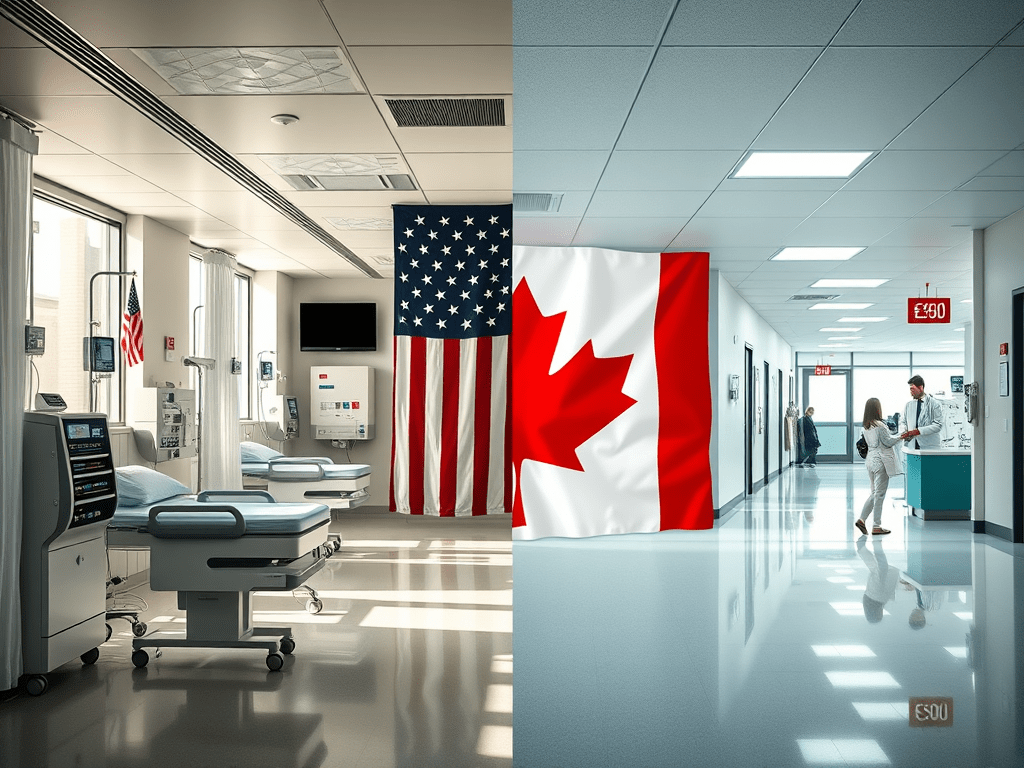
US vs. Canadian Healthcare: A Cost Comparison
The debate between the US and Canadian healthcare systems is a perennial one, often fueled by personal anecdotes and political rhetoric. To truly understand which system offers “better” value, we need to delve into the actual costs, considering everything from direct medical bills to the often-overlooked tax implications.
Both systems aim to provide quality care, but their funding mechanisms and patient experiences differ significantly. Let’s break down the financial realities.
The US Healthcare System: A Market-Driven Approach
The US healthcare system is predominantly private, relying on a complex mix of employer-sponsored insurance, individual plans, and government programs like Medicare and Medicaid.
Direct Costs for Patients:
- Premiums: Most Americans with private insurance pay monthly premiums, which can range from a few hundred to over a thousand dollars, depending on the plan, deductible, and family size.
- Deductibles: Before insurance coverage kicks in, patients often have to pay a significant deductible, sometimes thousands of dollars.
- Copayments and Coinsurance: Even after meeting the deductible, patients typically pay a copayment (a fixed amount per visit or prescription) or coinsurance (a percentage of the service cost).
- Out-of-Pocket Maximums: While there are out-of-pocket maximums to limit patient spending, these can still be substantial, often in the range of $8,000 to $15,000 for an individual or family annually.
- Uninsured Costs: For those without insurance, the costs of even routine medical care can be astronomical, leading to medical debt, which is a leading cause of bankruptcy in the US.
Indirect Costs (Taxes):
While often framed as “private,” the US system also has significant public funding.
- Medicare Taxes: Americans pay a 1.45% Medicare tax on all earned income (employers match this, bringing the total to 2.9%). High-income earners pay an additional 0.9% Medicare surtax.
- Medicaid and Other Programs: A portion of general income taxes, state taxes, and other revenue sources fund Medicaid, CHIP (Children’s Health Insurance Program), VA healthcare, and other public health initiatives.
Overall US Spending: The US spends significantly more on healthcare per capita than any other developed nation. In 2022, it was estimated that the US spent over $12,500 per person on healthcare.
The Canadian Healthcare System: A Single-Payer Model
Canada operates under a universal healthcare system, often referred to as “Medicare” (distinct from the US program). It’s a publicly funded, single-payer system, meaning the government (primarily provincial and territorial governments) is the primary payer for most medically necessary services.
Direct Costs for Patients:
- No Premiums (for most services): Canadians generally do not pay monthly premiums for basic medical care.
- No Deductibles or Copayments (for most services): For physician visits, hospital stays, and most essential treatments, there are no direct patient charges at the point of service.
- Prescription Drugs: Prescription drugs dispensed outside of hospitals are generally not covered by the public system, though provincial plans often cover seniors, low-income individuals, and those with specific conditions. Many Canadians have private insurance (often employer-sponsored) to cover prescription drugs, dental care, vision care, and other services not included in the public system.
- Dental and Vision Care: Like prescription drugs, routine dental and vision care are typically not covered by the public system and require private insurance or out-of-pocket payment.
Indirect Costs (Taxes):
Canadian healthcare is funded primarily through general taxation. This means that a portion of income taxes, sales taxes, corporate taxes, and other government revenues directly funds the healthcare system.
- Higher Income Tax Rates: Canadians generally face higher income tax rates than their US counterparts, particularly in higher income brackets. These taxes directly contribute to the public healthcare fund.
- Other Taxes: Provincial sales taxes (PST) or Harmonized Sales Taxes (HST) also contribute to provincial revenues, which in turn fund healthcare.
Overall Canadian Spending: While Canada’s per capita healthcare spending is higher than many other developed countries, it is significantly lower than the US. In 2022, Canada spent approximately $8,800 per person.
The Cost Comparison: Apples and Oranges?
Comparing the “cost” is tricky because of the different funding mechanisms.
- US Perspective: Many Americans see the high deductibles, copayments, and monthly premiums as the direct cost. The taxes that fund Medicare and Medicaid might be less visible as “healthcare costs.”
- Canadian Perspective: Canadians might feel the impact of higher income taxes, but they don’t face the fear of crippling medical bills for essential care. The “cost” is diffused through the tax system.
Let’s consider an example:
Imagine two individuals, one in the US and one in Canada, both earning $70,000 annually.
- US Individual:
- Might pay $500/month ($6,000/year) in insurance premiums.
- Could face a $3,000 deductible before insurance kicks in.
- Pays 1.45% ($1,015) in Medicare taxes.
- Contributes indirectly to Medicaid through general taxes.
- Total visible “healthcare spending” could easily exceed $9,000 before any major medical events. If a major event occurs before the deductible is met, out-of-pocket costs could skyrocket.
- Canadian Individual:
- Pays no direct premiums, deductibles, or copayments for essential services.
- Their income tax rate will be higher, with a portion of those taxes directly funding healthcare. For example, a significant portion of provincial income tax is allocated to healthcare.
- If they have private insurance for prescriptions or dental, they would pay premiums for that, perhaps $50-$100/month.
- The “cost” is primarily absorbed into the tax system, making it less visible as a direct healthcare expense.
The “Better” System: A Value Judgment
Defining “better” depends heavily on individual priorities and values.
Arguments for the US System (for some):
- Choice and Access (for those with good insurance): With good private insurance, individuals can often choose their doctors and specialists and access a wide range of cutting-edge treatments with potentially shorter wait times for elective procedures.
- Innovation: The market-driven nature is sometimes credited with fostering greater medical innovation.
Arguments for the Canadian System:
- Universal Access: Everyone, regardless of income or employment status, has access to medically necessary services without fear of financial ruin. This eliminates medical bankruptcies for essential care.
- Cost Efficiency (overall): Despite higher taxes, the single-payer system eliminates much of the administrative overhead associated with multiple private insurers, leading to lower per capita spending than the US.
- Improved Public Health Outcomes: Universal access can lead to earlier diagnosis and treatment, potentially improving overall public health.
Challenges:
- US System: High costs, significant disparities in access and quality based on insurance status, and the burden of medical debt.
- Canadian System: Longer wait times for some elective procedures and specialist appointments, and a lack of public coverage for prescription drugs, dental, and vision care.
Conclusion
When comparing the actual costs, the Canadian system, while funded by higher taxes, generally results in lower direct out-of-pocket costs for essential medical services for its citizens. The cost is collectivized through taxation. In the US, the cost is fragmented, with significant burdens falling directly on individuals through premiums, deductibles, and copayments, even with insurance.
Ultimately, the question of which system is “better” often boils down to a fundamental philosophical difference: is healthcare a right or a commodity? The US leans towards the latter, while Canada firmly embraces the former. While both systems have their strengths and weaknesses, the Canadian model offers a compelling argument for greater financial equity and universal access to basic medical care.
 Canadian Country Life
Leave a comment