
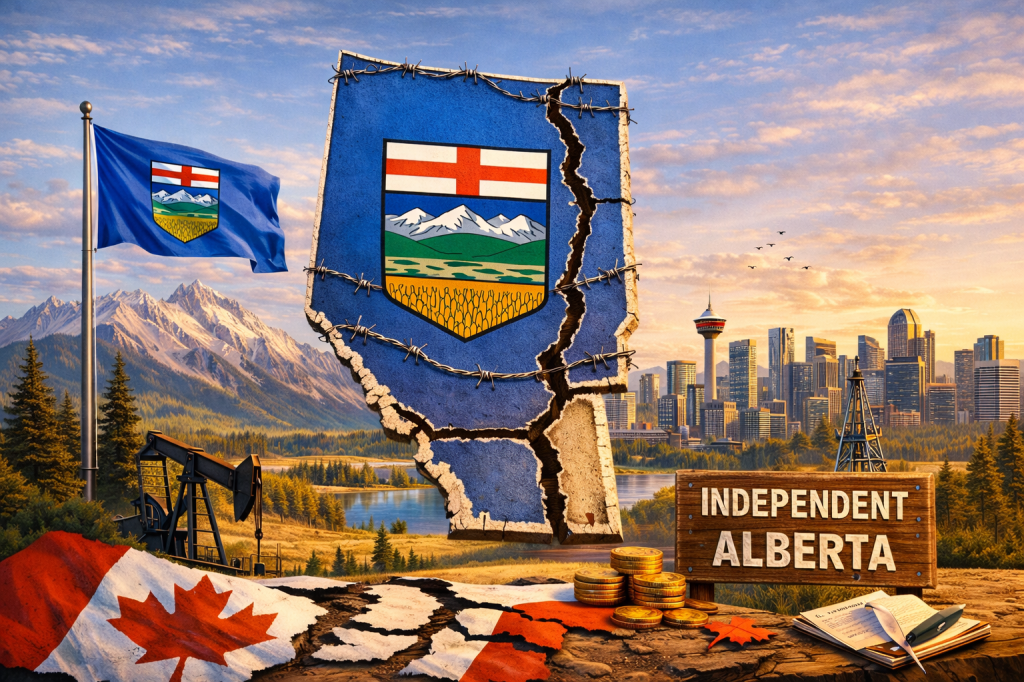
In early 2026, the conversation around Alberta separation has shifted from a fringe internet movement to a tangible political event, with Elections Alberta approving a petition for a referendum.
For many Albertans, this is about a feeling of “status loss” and the perception that their province—the engine of Canada’s economy—is being managed for decline by a distant federal government. However, as the debate intensifies, a massive gap remains between the romanticized idea of independence and the “cold math” of reality.
1. Why Some Albertans Want Out
The push for separation isn’t just about money; it’s about a fundamental breakdown in trust.
- Economic Frustration: Proponents point to the fact that Alberta often pays billions more in federal taxes than it receives back in transfers. There is a deep sense that the province is “propping up” a system that then turns around and blocks its primary industry.
- Policy Interference: Federal mandates on net-zero electricity, oil and gas emissions caps, and the “no new pipelines” law (Bill C-69) are viewed as direct attacks on the Albertan way of life.
- Political Isolation: With federal elections often decided in the Greater Toronto Area (GTA) and Quebec before polls even close in the West, many Albertans feel their votes simply do not matter in the current configuration of Parliament.
2. The Realities “Leavers” Often Overlook
While the grievances are real, the proposed solution of independence carries risks that could leave the province significantly worse off.
- The Landlocked Trap: Separating doesn’t solve the pipeline problem; it worsens it. As a sovereign nation, Alberta would lose its constitutional right to move goods across Canadian provinces. International law does not guarantee a landlocked state the right to build new pipelines through a neighbor’s territory against their will.
- U.S. Vulnerability: Without Canada, Alberta would have exactly one customer: the United States. Many “Wexit” supporters assume the U.S. would welcome them with open arms, but economists warn that Washington would likely treat an independent Alberta as a “distressed asset,” dictating harsh trade terms and potentially even pushing for annexation.
- Currency and Credit: A “New Alberta Dollar” tied solely to oil prices would be incredibly volatile. Additionally, leaving Canada means losing the stability of the Canadian dollar and the shared backing of the national credit rating, likely leading to skyrocketing interest rates for the new country.
- The First Nations Factor: Much of Alberta’s land is governed by Treaties between the Crown and Indigenous Peoples. Separation would trigger massive legal battles, as many First Nations have already stated they have no interest in leaving Canada or joining a new Alberta state.
3. The Path to a Happy Confederation
Fixing Canada doesn’t require a divorce; it requires a new “living arrangement.” Here is how we can bridge the gap:
Economic Reconciliation
- Trade Corridors: Establishing “National Strategic Corridors” that guarantee the movement of energy, minerals, and grain across provincial borders would treat Alberta’s resources as a national priority rather than a provincial burden.
- Equalization Reform: Modernizing the formula to ensure it doesn’t penalize provinces for developing their own resources would go a long way in cooling tempers.
Decentralizing Power
- Move the Capital (Sort of): To fix the “Ottawa Bubble,” federal departments should be moved to the regions they regulate. Why is Natural Resources Canada in Ottawa? Move it to Calgary. Move Agriculture to Regina. Let the public service live among the people they serve.
- Senate Reform: A “Triple-E” Senate (Equal, Elected, Effective) would give Alberta the regional balance of power it lacks in the House of Commons.
A New Energy Bargain
- Technology Over Taxes: Shifting the focus from “production caps” to “carbon capture and innovation” allows Alberta to remain an energy leader while meeting climate goals. If the rest of Canada wants a green transition, it must help fund the technology to make it happen, rather than simply closing the taps.
The Bottom Line: Alberta is stronger within Canada, and Canada is undeniably weaker without Alberta. Separation is a high-stakes gamble with a low probability of success, but the “alienation” driving it is a signal that the status quo is broken.
 Canadian Country Life
Leave a comment