Canada is a land of massive landscapes, polite people, and a surprisingly high number of moose. But if you dig a little deeper than the “Great White North” postcards, you’ll find a country filled with quirks that leave the rest of the world scratching their heads.
Whether you’re planning a visit or just curious about our neighbors to the north, here is a guide to the wonderfully weird things that make Canada truly unique.
1. The “Milk in a Bag” Mystery
If you walk into a grocery store in Ontario or Quebec, don’t look for a gallon jug. Instead, you’ll find three-packs of plastic milk bags.
- The Ritual: You take one bag, drop it into a specially sized plastic pitcher, snip the corner, and pour.
- The Why: It started in the late 1960s as a way to adapt to the metric system—plastic bags were easier to resize than glass bottles or cartons. Today, it’s just a nostalgic (and eco-friendly) way to get your calcium.
2. An Obsession with Kraft Dinner (KD)
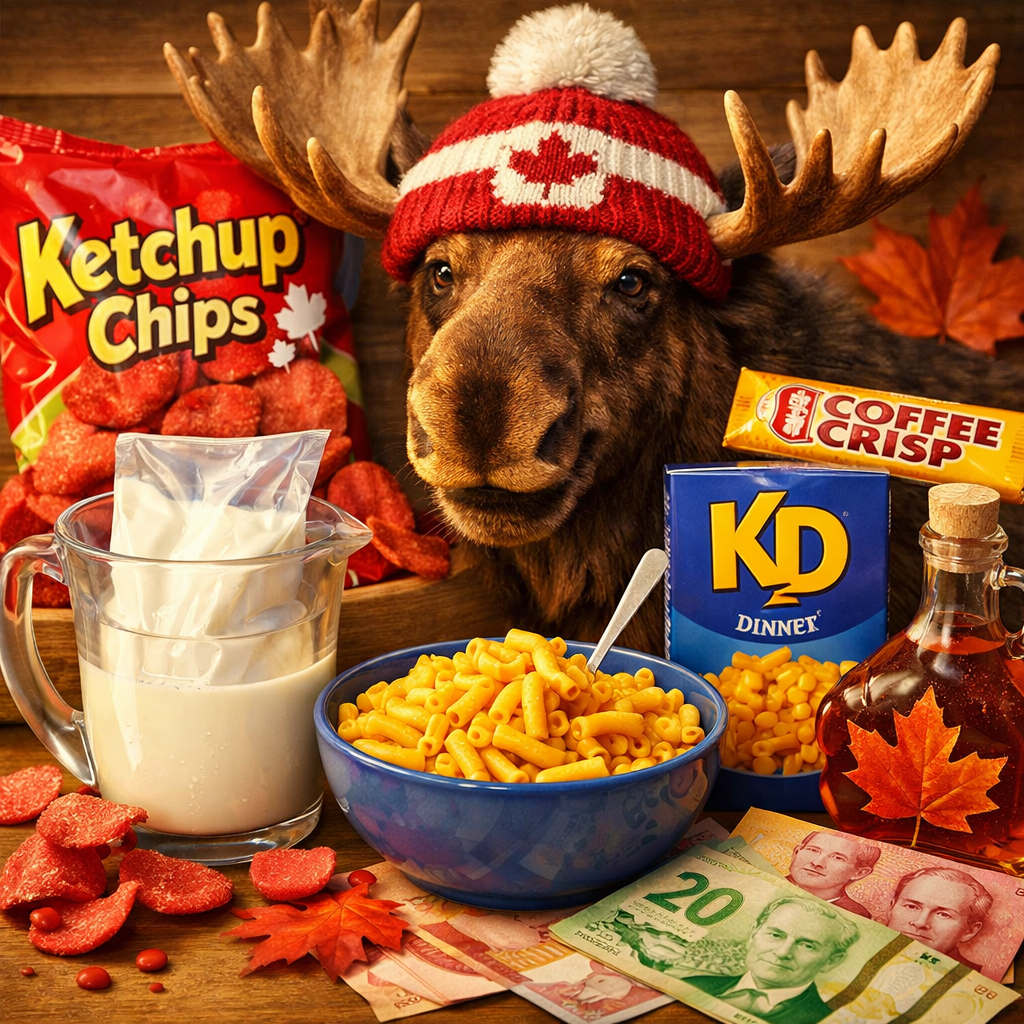
Canadians don’t just like Mac and Cheese; they are statistically obsessed with it. Canadians eat 55% more Kraft Dinner than Americans. It’s so culturally significant that it’s often referred to simply as “KD.” In fact, it’s considered an unofficial national dish, right up there with poutine.
3. The “Sorry” Law
The stereotype is true: Canadians apologize for everything. If you step on a Canadian’s foot, they will likely apologize to you. This became such a legal headache that Ontario passed the Apology Act in 2009. The law states that an apology does not constitute an admission of guilt or liability in court. It’s literally a legal hall pass to be polite.
4. Money You Can’t Tear (and That Might Smell Like Syrup)
Canadian banknotes are made of a polymer (plastic) rather than paper. They have transparent windows, holograms, and are nearly impossible to rip.
- The Legend: There is a long-standing urban legend that the $100 bill smells like maple syrup. While the Bank of Canada denies adding any scent, many Canadians swear they can catch a whiff of the sugar shack when they open their wallets.
5. Quirky Snack Flavors
If you visit a Canadian vending machine, you’ll see some colors that don’t exist elsewhere:
- Ketchup Chips: Imagine a salt and vinegar chip, but hit with a blast of sweet, tangy tomato.
- All-Dressed Chips: A chaotic but delicious blend of BBQ, salt, vinegar, and onion flavors all on one chip.
- Coffee Crisp: A light, wafer-based chocolate bar that is a mandatory souvenir for any traveler heading south.
6. Santa is a Canadian Citizen
Every year, millions of children write to the North Pole. In Canada, those letters actually get an answer.
- The Address: Santa Claus, North Pole, H0H 0H0, Canada.
- The Staff: Canada Post volunteers (the “Postal Elves”) respond to over a million letters a year in over 30 languages. In 2008, the Canadian government even officially declared Santa a Canadian citizen.
7. The Gravity of the Situation
In the Hudson Bay region, gravity is actually lower than the rest of the world. Due to the shifting of the Earth’s crust after the last ice age, the area has less mass, meaning you would technically weigh about a tenth of an ounce less there than you would in, say, Florida.
More Honorable Mentions:
- BeaverTails: Not actual tails, but delicious, flat, fried dough pastries topped with cinnamon and sugar.
- The Toonie: Canadians call their one-dollar coin a “Loonie” (because of the loon bird on it) and their two-dollar coin a “Toonie” (to rhyme with Loonie).
- The Hair Freezing Contest: Every year in the Yukon, people dip their hair in hot springs and let the -30°C air freeze it into wild, icy sculptures.
Since you’re already braving the concept of bagged milk and apologetic laws, you’re ready for the “Advanced Course.” Surviving a Canadian winter is less about endurance and more about a very specific set of social and physical skills.
Here is your starter kit for navigating the “True North Strong and Free.”
Part 1: The Winter Survival Guide
Canadian winters aren’t just cold; they are a lifestyle choice. If you want to make it to April without losing your mind (or a toe), follow these rules:
- The “Dress Like an Onion” Strategy: It’s all about layers. You need a base layer (wicking), a middle layer (insulation), and an outer shell (windbreaker). If you wear one giant heavy coat over a t-shirt, you’ll sweat while walking and then freeze the moment you stop.
- The “Winter Tire” Debate: Depending on where you are (looking at you, Quebec), winter tires are legally mandatory. In the rest of the country, they’re just “highly suggested” by everyone you meet. Never start a conversation about tire brands unless you have 45 minutes to spare.
- Master the “Mall Walk”: When it’s -30C outside, the local shopping mall becomes the municipal track. You will see people of all ages power-walking in the climate-controlled corridors just to keep their legs moving.
- The Frozen Hair Trick: If you go outside with wet hair, it will freeze into brittle needles within 60 seconds. It’s a great science experiment, but a terrible way to start a workday.
Part 2: Essential Canadian Slang
To truly fit in at a Tim Hortons or a backyard rink, you need to speak the language. Here is a quick translation guide:
| Term | Translation | Example |
| Double-Double | A coffee with two creams and two sugars. | “I’ll grab a large double-double and a box of Timbits.” |
| Toque (pronounced tuke) | A knit winter hat or beanie. | “Don’t forget your toque, it’s a brass monkey out there!” |
| Give’er | To put in maximum effort or go fast. | “The hill is steep, just give’er!” |
| Keener | Someone who is overly eager or a “teacher’s pet.” | “Look at Steve doing extra credit, what a keener.” |
| Dart | A cigarette. | “Goin’ out for a dart, be back in five.” |
| Mickey | A small (375ml) bottle of liquor. | “Just grabbing a mickey for the party.” |
Part 3: The “Etiquette” of the North
- The Door Hold: Canadians will hold a door for someone who is still 20 feet away. This creates a “politeness paradox” where you feel obligated to do a little awkward jog-shuffle so they aren’t waiting too long.
- The Outdoor Rink (ODR): If there is a patch of ice, there is a hockey game. The rules are simple: anyone can join, and the most experienced player usually spends their time passing to the youngest kid on the ice.
- The “Eh” Spectrum: It’s not just a filler word; it’s a tool. It turns a statement into a question (“Nice day, eh?”) or adds emphasis (“That was a long drive, eh?”).
Pro Tip: If you see a “Danger: Moose” sign, believe it. They are much larger than they look in movies, and they have no respect for your car’s insurance policy.
 Canadian Country Life
Leave a comment