
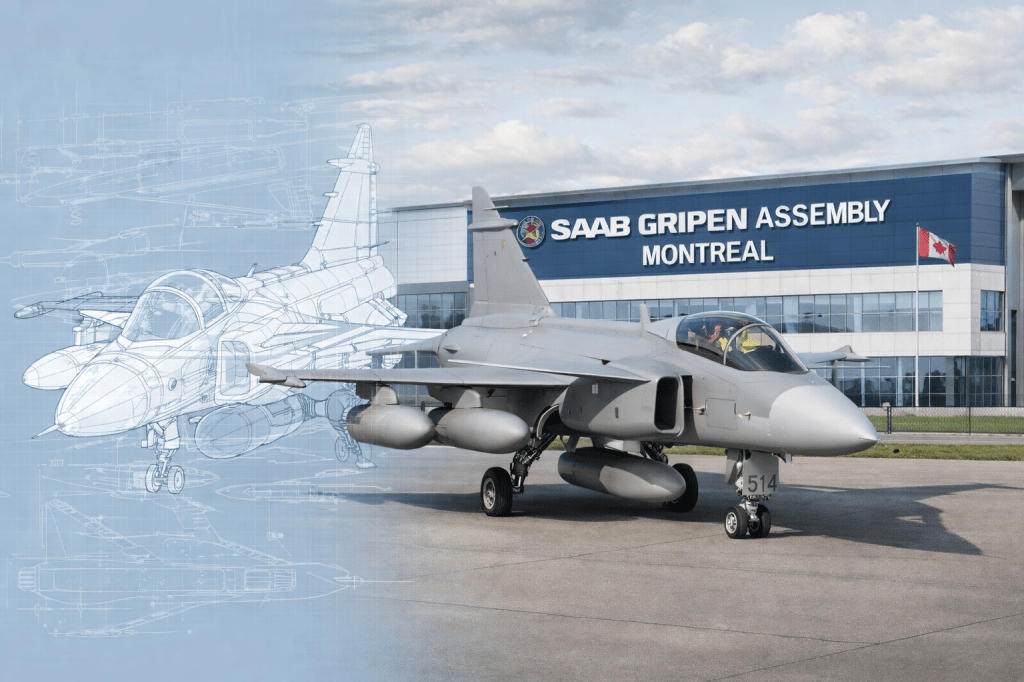
Gripen to Montreal: A New Era for Canadian Aerospace?
The aerospace industry in Canada has long been a source of national pride, innovation, and economic prosperity. From Bombardier’s regional jets to the numerous specialized companies contributing to global aviation, Canada has a significant footprint in the skies. Now, a new proposal is stirring excitement, with the potential to elevate Canada’s aerospace standing even further: the establishment of a Saab Gripen assembly plant in Montreal.
This isn’t just about building fighter jets; it’s about a strategic investment that could ripple through the Canadian economy, bolstering high-tech manufacturing, creating skilled jobs, and cementing Canada’s position as a global aerospace leader.
The Gripen’s Appeal: A Modern Contender
First, let’s understand why the Gripen E/F, manufactured by the Swedish aerospace and defense company Saab, is such a compelling aircraft. It’s a single-engine, multi-role fighter known for its:
- Agility and Performance: Designed for superior maneuverability and combat effectiveness.
- Cost-Effectiveness: Often touted as a more affordable option compared to some of its competitors, both in acquisition and operational costs.
- Advanced Avionics and Sensor Fusion: Incorporating cutting-edge technology for enhanced situational awareness and combat capability.
- Robust Electronic Warfare Suite: Providing strong defensive capabilities against modern threats.
- Ease of Maintenance: Designed for quick turnaround times and operational readiness, which is crucial for air forces.
- Interoperability: Capable of seamlessly integrating with NATO and allied forces.
These attributes make the Gripen a strong contender for various air forces around the world, including Canada’s, as it looks to replace its aging CF-18 Hornet fleet.
The Proposed Montreal Assembly Plant: What We Know
Details are still emerging. The proposal focuses on Saab establishing a final assembly and checkout (FACO) facility. This facility is for the Gripen E/F in Montreal, Quebec. This isn’t just a simple bolt-on operation; it signifies a deeper commitment and a significant transfer of technology and expertise.
Here’s what such a plant could entail:
- Final Assembly: The complete assembly of Gripen aircraft from major components shipped from Sweden. This includes fitting engines, wings, tails, and integrating complex electronic systems.
- Testing and Certification: Rigorous testing of the assembled aircraft occurs both on the ground and in the air. This testing ensures they meet stringent performance and safety standards.
- Maintenance, Repair, and Overhaul (MRO): The plant could evolve to become a hub for MRO activities. This development would serve not just Canadian Gripens, but potentially other international customers too.
- Research and Development (R&D) Collaboration: A physical presence often leads to closer collaboration on future upgrades. It also fosters technological advancements. This collaboration may potentially involve Canadian universities and research institutions.
- Supply Chain Integration: Initially, major components would come from Sweden. However, there would be significant opportunities for Canadian companies to join the supply chain. They could provide various parts, systems, and services.
Why Montreal? A Perfect Fit
Montreal’s selection as a potential site is no accident. The city and the surrounding Quebec region boast a formidable aerospace ecosystem:
- Skilled Workforce: There is a deep pool of highly skilled engineers, technicians, and aerospace workers. This talent is fueled by excellent educational institutions like McGill University, Concordia University, and École de technologie supérieure (ETS).
- Established Infrastructure: Existing aerospace manufacturing facilities, test centers, and logistical networks that could be adapted or expanded.
- Government Support: Both provincial and federal governments have historically been strong supporters of the aerospace sector, understanding its strategic importance.
- Innovation Hub: Montreal is a recognized hub for innovation. It excels particularly in AI, advanced manufacturing, and software development. All of these fields are increasingly critical to modern aerospace.
Economic Benefits: A Tailwind for Canada
The establishment of a Gripen assembly plant in Montreal would bring a cascade of economic benefits across Canada:
- Job Creation: This is arguably the most immediate and impactful benefit. We’re talking about hundreds, if not thousands, of high-quality, well-paying jobs in manufacturing, engineering, logistics, and management. These aren’t just direct jobs at the plant but also indirect jobs created throughout the supply chain and service industries.
- Technological Advancement & Knowledge Transfer: A FACO plant provides access to advanced manufacturing processes. It also offers cutting-edge aerospace technologies and proprietary knowledge from Saab. This will elevate the expertise within the Canadian aerospace sector.
- Strengthening the Supply Chain: Canadian companies, from small specialized component manufacturers to larger systems integrators, would have unparalleled opportunities. They could become part of the global Gripen supply chain. This means new contracts, expansion, and increased exports.
- Boosting R&D Investment: Saab’s presence could lead to increased R&D investment in Canada. It may foster collaboration with universities and research institutions. This collaboration could drive innovation in areas like materials science, avionics, and software.
- Economic Diversification: While Canada already has a robust aerospace sector, a fighter jet assembly plant diversifies its portfolio. It adds a significant defense manufacturing capability.
- Export Potential: If Canada were to acquire the Gripen, a domestic assembly plant could become a regional hub for exports. This would be for other Gripen operators in the Americas. It would generate further economic activity and attract foreign investment.
- Enhanced National Security & Sovereignty: Beyond economics, having a domestic capability to assemble its own fighter jets provides huge benefits. It significantly enhances Canada’s national security. It also boosts strategic autonomy. It reduces reliance on foreign entities for critical defense assets.
Looking Ahead: The Decision Point
The proposal for a Gripen assembly plant in Montreal is inextricably linked to Canada’s ongoing Future Fighter Capability Project (FFCP). This project aims to procure 88 new fighter jets. The F-35A Lightning II is currently considered the leading contender. However, Saab’s Gripen E/F remains a strong candidate. It is especially attractive due to the industrial benefits package it offers, including the assembly plant.
The decision will ultimately rest on a complex evaluation of capability, cost, and industrial benefits. However, the prospect of a Gripen assembly plant in Montreal presents a compelling vision for Canada’s aerospace future. It promises innovation, economic growth, and a reinforced position on the global stage.
This isn’t just about buying jets; it’s about building a future. And for Canada, a Gripen plant could be a powerful tailwind for a new era in aerospace.
 Canadian Country Life
Leave a comment