Canada’s landscape is a vast tapestry of geography, but its soul is defined by the diverse cultures, languages, and spiritualities of the First Nations, Inuit, and Métis peoples. To understand Canada, one must first understand the deep-rooted connections these nations have maintained with the land since time immemorial.
1. The Three Distinct Pillars
Indigenous identity in Canada is not a monolith. The Constitution recognizes three distinct groups, each with its own unique history and governance.
- First Nations: Comprising over 600 communities and dozens of distinct languages (such as Cree, Anishinaabemowin, and Haida). They span from the Atlantic to the Pacific and up into the subarctic.
- Inuit: The traditional inhabitants of the Arctic (Inuit Nunangat). Their culture is a masterclass in resilience, adapted to the sea ice and tundra.
- Métis: A distinct culture emerging from the unions of First Nations women and European fur traders. They possess their own language (Michif) and a rich history of resistance and community.
2. Core Beliefs and Worldviews
While every nation has its own specific protocols, several “thread-lines” of spirituality and philosophy connect many Indigenous cultures across the continent.
The Interconnectedness of All Things
Most Indigenous worldviews are holistic. There is no separation between the “human world” and the “natural world.” Animals, plants, water, and rocks are often viewed as kin—entities with their own spirits and rights.
The Medicine Wheel
Common among many First Nations, the Medicine Wheel is a symbol of balance and the interconnected nature of life. It typically represents the four directions, the four seasons, and the four aspects of an individual:
- Physical
- Mental
- Emotional
- Spiritual
Respect for the Land
The land is not a “resource” to be extracted; it is a relative to be protected. This is often expressed through the Seventh Generation Principle, an ancient Haudenosaunee philosophy that requires the current generation to consider how their actions will affect their descendants seven generations into the future.
3. Traditions and Sacred Ceremonies
Ceremony is the heartbeat of Indigenous life, serving to heal, celebrate, and maintain the balance of the universe.
- Smudging: The burning of sacred medicines (sage, cedar, sweetgrass, or tobacco) to purify the mind and spirit.
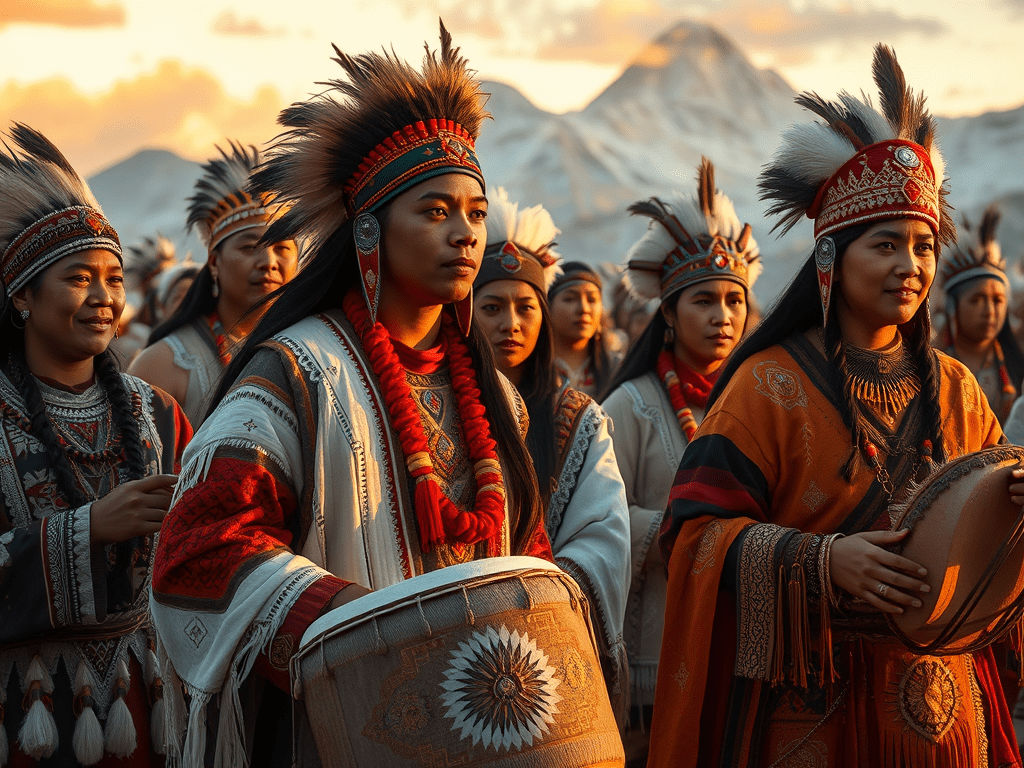
- The Powwow: A vibrant cultural gathering involving dance, drumming, and singing. It is both a social event and a powerful display of cultural pride and endurance.
- Potlatch: Central to Northwest Coast cultures (like the Kwakwaka’wakw), this complex system involves gift-giving and feasting to validate status and redistribute wealth.
- Throat Singing (Katajjaq): A traditional Inuit practice, often a friendly competition between two women mimicking the sounds of nature and the environment.
4. Resilience and Modern Reclamation
It is impossible to discuss Indigenous culture without acknowledging the history of colonization, including the residential school system and the banning of ceremonies (like the Potlatch) for decades.
Despite these attempts at erasure, Indigenous cultures are currently experiencing a massive Renaissance.
- Language Revitalization: Communities are using technology and immersion schools to bring back languages like Inuktitut and Mohawk.
- Art and Media: From the haunting carvings of the Haida to modern Indigenous hip-hop and cinema, artists are using their heritage to tell new stories.
- Governance: Nations are reclaiming their right to self-government and traditional legal systems.
“Our culture is not a relic of the past; it is a living, breathing guide for our future.” — Common Indigenous Sentiment.
The Path Forward
Learning about Indigenous cultures is a continuous journey of unlearning and listening. By acknowledging the richness of these beliefs, we move closer to a more respectful and truthful relationship with the land and its original caretakers.
 Canadian Country Life
Leave a comment