
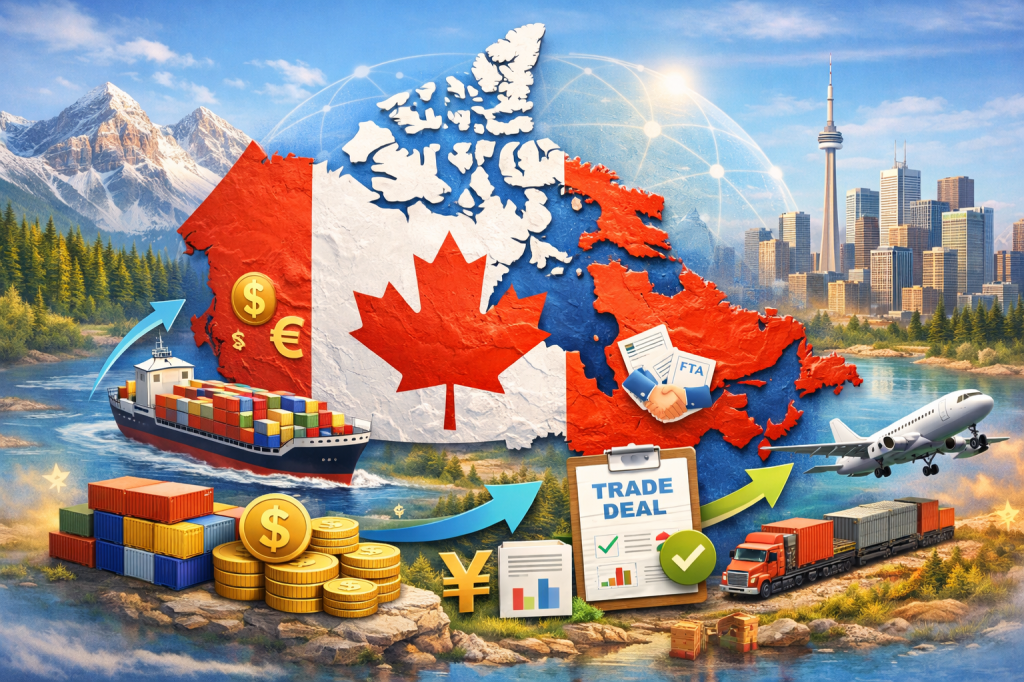
Sovereignty-First
In 2026, the North American trade landscape has shifted from cooperation to a high-stakes chess match. With the mandatory CUSMA (USMCA) review beginning July 1, 2026, and a Trump administration doubling down on protectionist tariffs, Canada finds itself in a position where traditional diplomacy may no longer suffice.
Under the leadership of Prime Minister Mark Carney, Canada is pivotting toward a “Sovereignty-First” strategy. This approach moves beyond retaliatory tariffs on ketchup and bourbon, instead leveraging Canada’s control over the essential “plumbing” of the American economy.
1. Energy Leverage: Turning Off the “Northern Tap”
The United States is the world’s largest energy consumer, and Canada is its most vital supplier. While the U.S. has achieved high domestic production, the “energy-intensive” nature of the 2026 AI boom—driven by massive data centers—has made American power grids fragile.
The Electricity Levy
In early 2026, Ontario and Quebec signaled a paradigm shift. Ontario Premier Doug Ford and the federal government discussed a 25% levy on all electricity exports to the U.S. By treating electricity as a strategic asset rather than a commodity, Canada can:
- Force Negotiations: Directly increase costs for U.S. manufacturers in the Midwest and Northeast.
- Prioritize Domestic AI: Redirect surplus clean energy to Canadian tech hubs, starving U.S. competitors of the low-cost power they need to train next-generation models.
Oil and Gas “Recalibration”
Canada provides roughly 24% of total U.S. oil consumption. U.S. refineries in the Midwest are specifically engineered to process Canadian heavy crude.
- Infrastructure Slowdown: By citing “environmental sovereignty” or “maintenance requirements,” Canada could strategically slow the flow of pipelines like Enbridge’s Line 5.
- The Cost of Retooling: Without Canadian heavy crude, U.S. refineries face billions in retooling costs or an expensive dependence on volatile sources like Venezuela.
2. The Critical Minerals “Vault”
The Trump administration’s “Project Vault”—a plan to stockpile minerals for defense and EVs—highlights a major American vulnerability: they have the demand, but Canada has the supply.
Canada holds 34 minerals deemed “critical” by the U.S., including lithium, cobalt, and nickel.
- Export Restrictions: Prime Minister Carney can implement “Value-Add Mandates,” requiring that minerals be refined in Canada before export. This would effectively move high-paying industrial jobs from the Rust Belt to Northern Ontario.
- Preferential Alliances: Canada can tie mineral access to CUSMA concessions. If the U.S. imposes 25% tariffs on Canadian steel, Canada can respond with a “Security Surcharge” on the minerals required to build U.S. fighter jets and batteries.
3. Controlling the Arteries: The St. Lawrence and Great Lakes
The Great Lakes-St. Lawrence Seaway is the industrial heart of North America, supporting $6 trillion in GDP and 30% of all U.S.-Canada trade.
The Seaway “Squeeze”
Canada controls 13 of the 15 locks between Montreal and Lake Erie.
- Regulatory Friction: By introducing stringent new environmental or invasive species inspections at Canadian locks, Canada can create significant “logistical lag” for U.S. agricultural exports heading to Europe and Africa.
- Vessel Decertification: Just as the U.S. has threatened to decertify Canadian aircraft (like Bombardier), Canada could implement “Safety Audits” on U.S.-flagged “Lakers,” stalling the movement of iron ore and grain.
4. Border and Airspace Sovereignty
The 5,525-mile border is often called the “longest undefended border,” but in a trade war, it becomes a tool of administrative friction.
“Smart” Border Slowdowns
Under the Customs Act, Canada can increase the intensity of inspections for “security reasons.”
- The Just-in-Time Crisis: The North American auto industry relies on parts crossing the border multiple times before a car is finished. A 4-hour delay at the Ambassador Bridge in Windsor-Detroit would cost the U.S. auto industry hundreds of millions per day.
- Enhanced Airspace Control: Canada can implement “Administrative Surcharges” for U.S. commercial carriers using Canadian airspace for transcontinental flights, or cite NORAD modernization needs to temporarily restrict “non-essential” U.S. commercial traffic in strategic corridors.
Conclusion: The “Team Canada” Gambit
The Carney administration’s strategy is clear: asymmetry. Canada cannot win a head-to-head tariff war with a country ten times its size. However, by leveraging its role as the provider of the U.S. economy’s “raw inputs”—energy, minerals, and transit—Canada can make the cost of American protectionism unbearable.
The goal is not to break CUSMA, but to prove that the “rules-based order” Carney once championed is only as strong as the mutual dependence of its members.
 Canadian Country Life
Leave a comment