
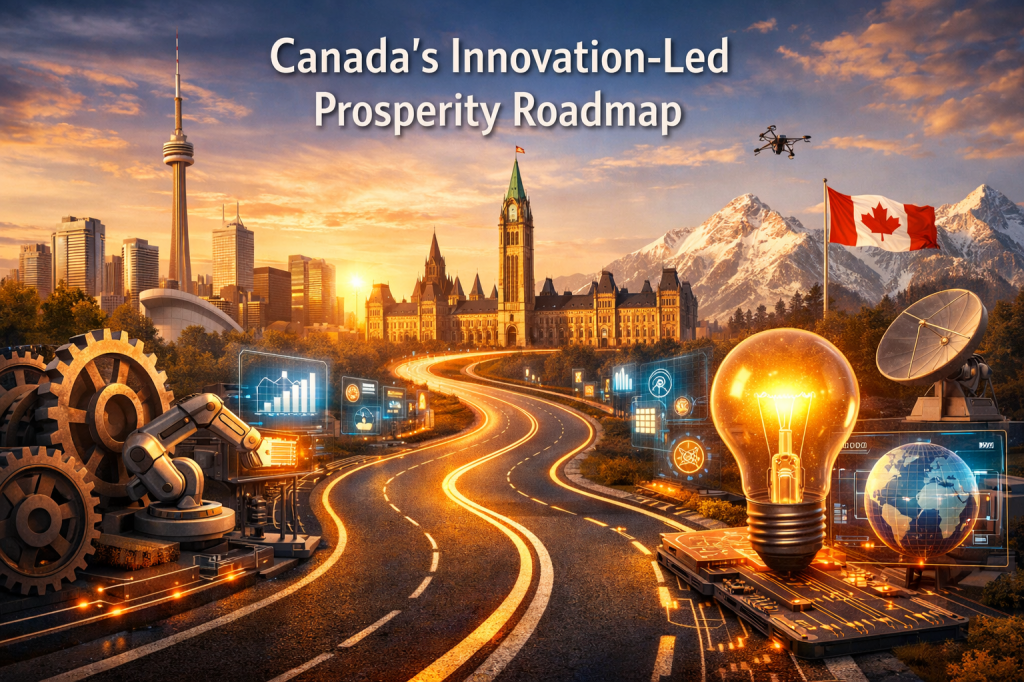
The Northern Engine: A Roadmap to Canada’s Innovation-Led Prosperity
Canada stands at a historic crossroads. For decades, the narrative of the Canadian economy has been dominated by two themes: being “hewers of wood and drawers of water” and a reliance on a few major trading partners. However, as we move through 2026, a new vision is emerging—one where Canada doesn’t just export raw materials, but processes them using homegrown AI, powers them with clean energy, and moves them through a hyper-efficient logistics network.
By intertwining our natural abundance with a highly educated, diverse population, Canada can build a self-sustaining “Northern Engine” that lowers the cost of living and cements our place as a global superpower of the 21st century.
1. Agriculture 2.0: From Fields to Bio-Labs
Canada is a breadbasket, but the future of agriculture is about more than just yield; it’s about value-added molecular farming and autonomous precision.
- AI-Driven Precision: By deploying autonomous platforms like the Saskatchewan-born DOT, farmers can reduce fertilizer and water waste by up to 40%. This isn’t just “green”—it lowers the input costs of food, directly fighting grocery inflation.
- Vertical & Modular Farming: Using modular construction and waste-heat recovery from industrial sites, Canada can grow fresh produce year-round in northern and urban environments, reducing the reliance on expensive imports from the southern US and Mexico.
- The Bio-Economy Loop: Instead of exporting raw timber or grain, we can use synthetic biology to turn agricultural waste into bio-plastics and carbon-storing building materials (like wheat-straw retrofit panels).
2. Advanced Manufacturing: The “Made Better in Canada” Mandate
The era of sending raw minerals abroad only to buy back the finished battery is ending. The goal is Value-Added Sovereign Capacity.
- The Critical Mineral Battery Loop: With the Critical Mineral Strategy, Canada is mapping its lithium, cobalt, and nickel reserves. By integrating AI-driven robotic extraction and refining, we can create a domestic supply chain for EVs and grid storage that creates thousands of high-tech manufacturing jobs in Ontario and Quebec.
- Modular Housing Factories: To solve the housing crisis, Canada must move home-building into the factory. 3D printing and mass-timber prefabrication can reduce construction timelines by 50%. This creates a new manufacturing sector that exports sustainable building solutions globally.
- SME Hypergrowth: By establishing “Technology Adoption Centres,” the government can help small Canadian manufacturers adopt Industry 4.0 (robotics and big data) to compete with global giants.
3. The Digital Infrastructure: AI, Security, and Logistics
Innovation is the “glue” that connects our vast geography.
- Sovereign AI Compute: Canada is a world leader in AI research (Mila, Vector Institute). By building national AI superclusters, we can provide Canadian startups with the “compute power” they need to develop proprietary algorithms for healthcare, logistics, and security without relying on foreign tech giants.
- The “Dig Once” Mandate: Integrating fiber-optic installation with every new road or pipeline project ensures that rural Canada has the high-speed connectivity required for remote work and digital education.
- Smart Logistics Corridors: Using AI to optimize the “Trade Diversification Corridors” (rail and port) can reduce the time and cost of moving goods. Faster logistics mean lower prices on store shelves.
4. Healthcare and Education: Investing in Human Capital
Our population is our greatest resource. Innovation here means better outcomes for less money.
- AI in Healthcare: From early cancer screening to drug discovery, AI can handle the “heavy lifting” of data, allowing doctors to focus on patient care. This reduces wait times and the overall cost of the public health system.
- Lifelong Learning Pathways: As automation changes the workforce, “micro-credentialing” in AI and advanced trades ensures our population is never obsolete. Integrating Indigenous Knowledge with STEM curriculum creates a unique, sustainable approach to resource management.
5. Creative Tech: Films, Entertainment, and Virtual Worlds
Canada is already a filming powerhouse, but the next step is Creative Technology Ownership.
- Virtual Production Hubs: Beyond providing “locations,” Canada is investing in LED volume stages and VFX technology. This intertwines with our tech sector—software developed for video games in Montreal is now used to simulate industrial digital twins in Calgary.
- Cultural Export: By using digital platforms to export Canadian-owned IP (Intellectual Property), we shift from a service provider for Hollywood to a global content creator, keeping the profits and the high-level creative jobs at home.
6. Transportation and Travel: Connecting the Mosaic
- Hydrogen and Electric Corridors: Utilizing our clean energy grid to power heavy transport (trucking and rail) reduces our carbon footprint and shields our economy from global oil price volatility.
- Northern Connectivity: Innovative air-ship technology or small modular reactors (SMRs) can provide cheap, clean energy and transport to remote northern communities, unlocking the economic potential of the Arctic.
The Intertwined Future
The beauty of this strategy is its interconnectivity. A mass-timber plant in BC provides the materials for modular housing in Toronto; an AI startup in Montreal provides the navigation for an autonomous harvester in Manitoba; and a film crew in Newfoundland uses a Canadian-made drone to capture world-class content.
By focusing on innovation at the point of origin, Canada can transform from a resource-rich nation into a high-tech powerhouse where a lower cost of living is the natural byproduct of a hyper-efficient, value-added economy.
This isn’t just a strategy for economic growth; it is a blueprint for National Resilience. By moving from a “buy-and-ship” commodity model to a “build-and-process” innovation model, Canada can decouple its prosperity from global market whims and lower the cost of living for every citizen.
Here is how the “Northern Engine” operates in detail.
1. Energy Sovereignty: The Small Modular Reactor (SMR) Revolution
Energy is the fundamental cost behind everything—food, heating, and manufacturing. Currently, northern and remote communities rely on expensive, carbon-heavy diesel shipped over thousands of kilometers.
- Remote Power: A new class of Micro-Modular Reactors (MMRs), like the 5 MWe project at Chalk River, can provide 20 years of carbon-free heat and power without refueling. This lowers the operating costs for remote mines and reduces utility bills for northern residents by up to 50%.
- Grid-Scale Deployment: Ontario is leading the world with the Darlington New Nuclear Project, building four 300 MWe SMRs. By 2029, these will provide enough clean baseload power to sustain 1.2 million homes and fuel the massive energy needs of AI data centers.
- The SMR-Hydrogen Link: These reactors can produce “Pink Hydrogen” at scale. This hydrogen can power heavy freight trucks and rail lines, creating a zero-emission logistics corridor that isn’t tied to fluctuating global oil prices.
2. The Critical Mineral Value Chain (CMVC)
Canada sits on 31 critical minerals, but the innovation lies in midstream processing.
- From Mine to Battery: Instead of shipping spodumene (raw lithium ore) to Asia, Canada is building a “Battery Alley” in Ontario and Quebec. New projects like the Ultium CAM and NextStar Energy plants are the beginning of a domestic supply chain where we mine, refine, and assemble the batteries that power the world.
- AI-Enabled Exploration: Using AI-driven geoscience, companies are mapping deep-subsurface deposits with 90% higher accuracy. This shortens the “exploration-to-extraction” timeline, which historically took 15 years, down to 5-7 years.
- Circular Manufacturing: Innovation in battery recycling (e.g., Li-Cycle) ensures that 95% of materials from old EVs stay in Canada to build new ones, creating a closed-loop economy that resists supply chain shocks.
3. High-Tech Logistics and the “First-and-Last Mile” Fund
Geography is Canada’s biggest challenge. We are solving it through digital and physical integration.
- Autonomous Northern Corridors: We are seeing the development of all-season autonomous trucking routes in the North. By removing the seasonal limitations of ice roads, we can provide year-round supplies to remote communities, drastically lowering the cost of goods.
- Digital Product Passports: Canada is implementing G7-aligned traceability standards. Every gram of nickel produced in Canada will have a “Digital Passport,” verifying its low-carbon footprint. This allows Canadian producers to charge a “Sustainability Premium” in global markets, bringing more wealth back to Canadian workers.
- The Kivalliq Link: Proposed 1,200km transmission and fiber corridors will bring both clean power and high-speed internet to Nunavut. This allows northern residents to participate in the Global Digital Economy (AI labeling, remote healthcare, film editing) without leaving their communities.
4. Advanced Education and AI Integration
To power these industries, we are revolutionizing how we train our population.
- AI-Assisted Trade Schools: We are integrating VR and AI into trade apprenticeships. A student in Nova Scotia can train on a virtual SMR maintenance platform or a robotic assembly line, accelerating the time-to-certification.
- The “Sovereign Compute” Initiative: Canada is building national supercomputing clusters to ensure our AI researchers (at MILA and Vector) have the hardware to build “Canadian-First” LLMs. These models are optimized for our specific needs—like optimizing the Canadian rail grid or managing our unique boreal forest health.
5. Film and Creative Tech: The “Virtual Production” Frontier
Canada is moving from being a “cheap film location” to a global tech owner in entertainment.
- Convergent Media: The same “Digital Twin” technology used to simulate a new mine in BC is being used by VFX studios in Vancouver and Montreal to create virtual film sets (LED Volumes). This creates a highly mobile, tech-savvy workforce that can switch between industrial engineering and high-end entertainment.
- IP Ownership: By incentivizing Canadian-owned studios, we ensure the profits from global hits stay in Canada, funding the next generation of creative infrastructure.
Conclusion: The Unified National Engine
When you intertwine these sectors, the result is a force multiplier:
- SMRs provide the cheap energy to…
- Refine Critical Minerals domestically, which are used to…
- Build Electric Freight and modular housing, which…
- Lower the Cost of Living and transport, while…
- AI and Education ensure every Canadian is equipped to lead these sectors.
 Canadian Country Life
Leave a comment