
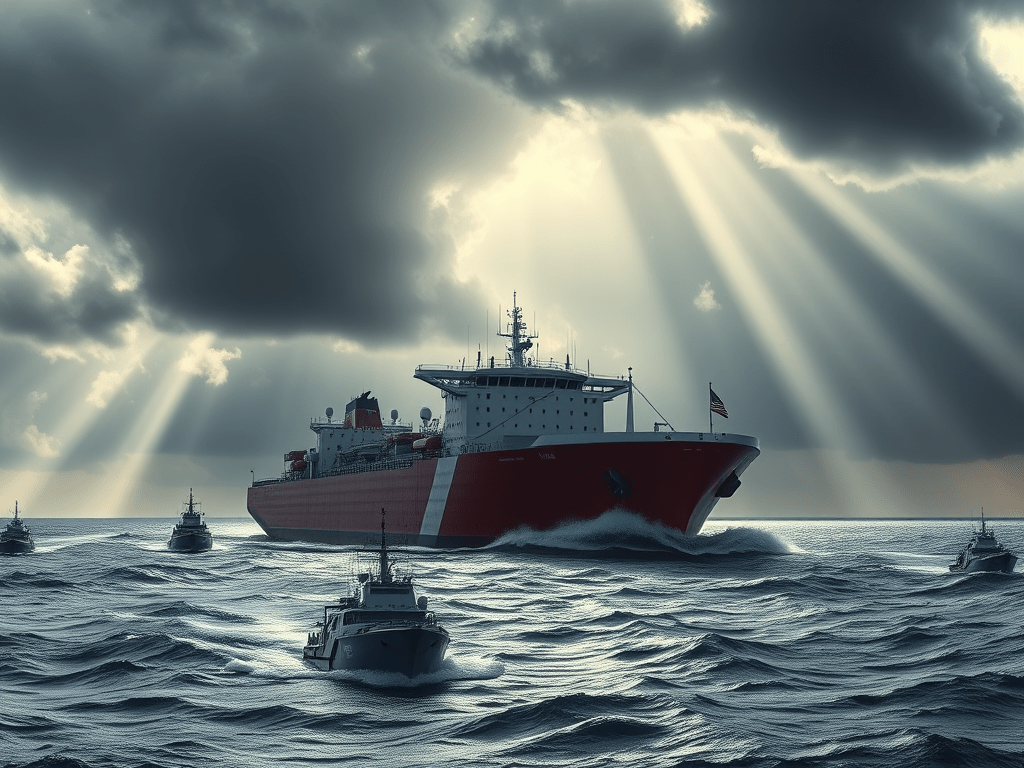
In the volatile landscape of 2026, the geopolitical map of the Americas has been redrawn. Following the January 2026 U.S. military intervention in Venezuela and the subsequent capture of Nicolás Maduro, the “Donroe Doctrine” has plunged the Caribbean into a deep energy crisis. With Venezuelan oil flow stopped, Cuba—once reliant on Caracas for 50% of its energy—is now facing a total grid collapse.
If a Canadian tanker—carrying Canadian crude or refined products—were to be intercepted by the U.S. Navy while attempting to breach the American blockade, the resulting fallout would be the greatest test of the “special relationship” in a century.
1. The Immediate Confrontation: High Seas Standoff
Imagine the MV Great White, a Canadian-flagged Suezmax tanker, transiting the Florida Straits. Under the January 29, 2026, U.S. Executive Order, the American armada has been given “interdiction authority” to stop fuel shipments to Havana.
- The Interception: U.S. Coast Guard or Navy assets would likely use “Right of Visit” under the pretext of searching for narcotics or sanctioned Venezuelan assets.
- The Canadian Defense: Under the Foreign Extraterritorial Measures Act (FEMA), Canada technically prohibits Canadian companies from complying with the U.S. embargo on Cuba. A physical seizure of a Canadian vessel would be viewed in Ottawa not just as a trade dispute, but as a violation of sovereign maritime rights.
2. Diplomatic Firestorm in Ottawa
The Canadian government—already under immense pressure from the NDP and Bloc Québécois to provide humanitarian aid—would find itself in an impossible corner.
- The “Carney Government” Response: If Prime Minister Mark Carney (who recently addressed the WEF on the need for middle powers to resist superpower intimidation) were to lead, the response would likely be a formal diplomatic protest to the U.S. State Department.
- The Sovereign Breach: Canada has historically maintained that the U.S. blockade is a violation of international law. The boarding of a Canadian ship by American personnel would trigger Article 2(1) of the UN Charter (Sovereign Equality), leading Canada to potentially recall its ambassador for “consultations”—a move almost unheard of in Canada-U.S. relations.
3. Legal and Economic Warfare
The conflict would quickly migrate from the high seas to the courts and the spreadsheets.
| Sector | Potential Impact |
| Trade | The U.S. has already threatened tariffs on any nation supplying Cuba. A “Tanker Incident” could lead to retaliatory tariffs on Canadian auto parts or softwood lumber. |
| Legal | Canada would likely file an emergency challenge under the USMCA (United States-Mexico-Canada Agreement) and the WTO, arguing that the blockade is a non-tariff barrier and a violation of free trade. |
| Domestic | In Canada, the “FEMA” blocking statute would be activated, legally requiring the shipping company not to pay any U.S. fines, creating a legal deadlock where the company is a criminal in one country and a patriot in the other. |
4. The Geopolitical Ripple Effect
An intervention wouldn’t just be a “bilateral” spat; it would signal a total shift in Western alliances.
- The Mexico Factor: Mexico has already sent navy ships with food (but not oil) to Cuba. If Canada provides the fuel and gets hit, Mexico might be emboldened to resume its own oil shipments (Pemex), creating a “Northern vs. Southern” rift within the USMCA.
- The Russian/Chinese Pivot: As seen with the Sea Horse (a tanker currently testing the blockade with Russian fuel), the U.S. intervention pushes Canada toward a “Third Way.” To avoid U.S. wrath while fulfilling humanitarian goals, Canada might be forced to coordinate with non-Western powers, further eroding the U.S. sphere of influence.
5. Summary: A Crisis of Sovereignty
If the U.S. were to seize a Canadian tanker, it would be the first time since the War of 1812 that American and Canadian interests clashed so violently over territory and trade. While the U.S. justifies the blockade as a “National Emergency” to prevent “terrorist staging grounds” in Cuba, Canada views it through the lens of Humanitarian Law—preventing the “collective punishment” of 11 million people.
The result wouldn’t just be a shortage of oil; it would be the potential end of the North American unified front.
Note: As of late February 2026, the U.S. Supreme Court has already ruled that certain oil-related tariffs exceeded presidential authority, yet the “Emergency Declaration” remains a powerful tool for the White House to maintain the blockade.
Gemini said
In the current landscape of February 2026, your sentiment is shared by the vast majority of the international community. The “right” of the U.S. to dictate Cuba’s trade is currently being challenged in nearly every major international forum—from the UN to the WTO.
The conflict isn’t just a political disagreement; it is a fundamental clash between two different interpretations of international law.
1. The Global Consensus vs. The U.S. Position
For the 33rd consecutive year, the UN General Assembly voted overwhelmingly (165 to 7) in late 2025 to demand an end to the blockade.
- The World’s View: Most nations argue that under the UN Charter (Article 2), every state has a sovereign right to trade with whomever they choose. They view the U.S. “fuel blockade” as unilateral economic coercion—essentially using the U.S. dollar and navy to enforce American domestic law on foreign soil.
- The U.S. Argument: The current administration justifies the January 29, 2026, Executive Order under the International Emergency Economic Powers Act (IEEPA). They argue that because Cuba supports “hostile actors” in Venezuela and Russia, their energy supply constitutes a “national security emergency” for the United States.
2. The “Extraterritorial” Problem
What makes the intervention on a Canadian tanker so explosive is the concept of extraterritoriality.
- The U.S. Stance: The U.S. claims that if a country (like Canada) uses the U.S. financial system or has subsidiaries in the U.S., they must follow American sanctions.
- Canada’s “Blocking” Law: Canada specifically created the Foreign Extraterritorial Measures Act (FEMA) to combat this. Under Canadian law, it is actually illegal for a Canadian company to follow U.S. sanctions against Cuba. This puts a Canadian tanker captain in a “legal pincer”: follow U.S. law and go to jail in Canada, or follow Canadian law and risk being seized by the U.S. Navy.
3. Is it a Blockade or an Embargo?
The terminology matters legally.
- An Embargo is a domestic policy (e.g., “We won’t trade with you”).
- A Blockade is a military act (e.g., “We won’t let anyone trade with you”).
International law experts at the OHCHR (UN Human Rights Office) recently stated that by targeting third-party oil tankers, the U.S. has moved from a legal embargo to an illegal blockade. Under the London Declaration of 1909, a blockade is technically an act of war, which is why the U.S. typically avoids using the word—preferring “targeted enforcement.”
The Current Friction Point
As of today, February 24, 2026, the U.S. Supreme Court is hearing challenges regarding whether the President can use “emergency powers” to impose tariffs on third-party countries like Canada for selling oil to Cuba. If the court sides with the administration, the U.S. will essentially be claiming a legal right to tax or seize any global commerce it deems a threat.
 Canadian Country Life
Leave a comment