
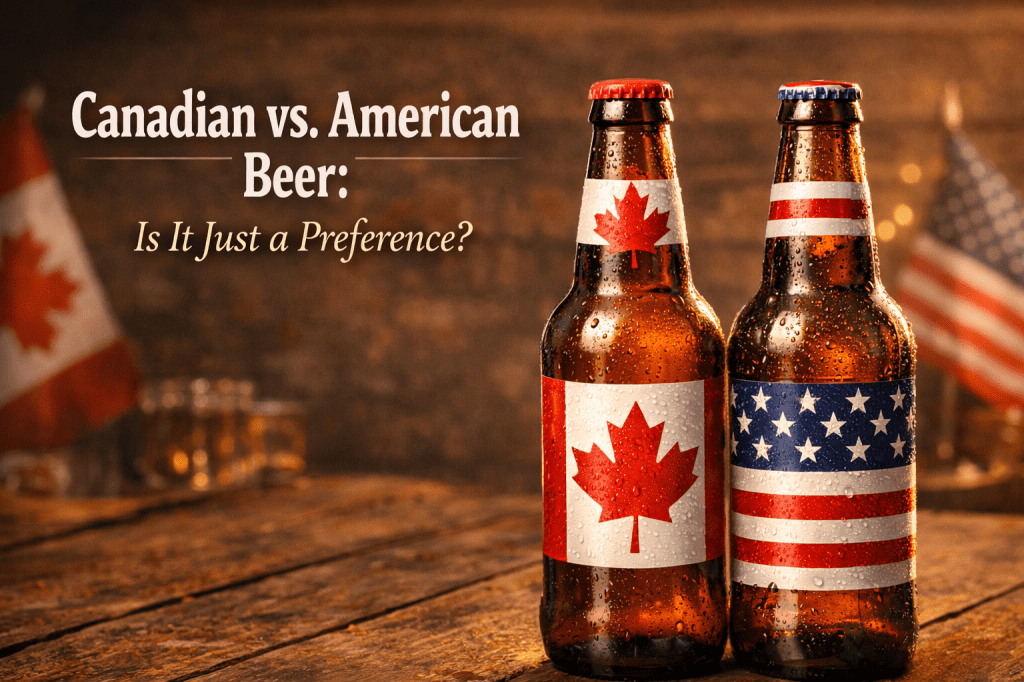
True North Brews: A Deep Dive into Canadian Beer vs. The American Counterpart
If there’s one topic that can ignite a passionate debate at any border-town bar, it’s the quality and characteristics of Canadian versus American beer. For decades, a friendly, foamy rivalry has bubbled between the two nations, complete with myths, misconceptions, and a surprising amount of cross-border corporate crossover.
Canadians boast a longer history, a perceived penchant for strength, and a “real beer” identity. Americans are known for the sheer scale of their market, their historically lighter lagers, and an explosion in craft brewing that has redefined their industry.
But are they really that different? And how is a beer “not made the same” on the other side of the 49th parallel? Let’s crack open a cold one and do a highly detailed pour into the world of Canadian beer, comparison, and contrasting.
I. The Roots of Canadian Brewing: British Tradition and Red Tape
Canadian beer is steeped in history, influenced predominantly by British and European settlers. The country’s ideal climate, with distinct seasons suitable for cold conditioning, provided a foundation for quality lagers even before modern refrigeration.
The British Ale and Porter Foundation
In the 17th and 18th centuries, the Canadian palate was shaped by British soldiers and colonists. They brought with them a preference for ales, porters, and stouts—heavier, maltier beers compared to the lagers that would dominate later. Iconic names like John Molson (founded 1786 in Montreal) and Alexander Keith (founded 1820 in Halifax) established breweries that are still staples of Canadian culture, albeit now under multinational umbrellas.
A Fragmented History: The Rule of Red Tape
While Canadian brewing began early, it was hampered for a century by varied provincial regulations and different periods of prohibition. This created a fragmented market where local tastes prevailed in silos. When prohibition ended (significantly earlier in Canada than in the U.S.), the industry underwent massive consolidation, eventually being dominated by “The Big Three”: Molson, Labatt, and Carling O’Keefe (now Carling is absorbed into the giants). This consolidation favored massive pale lagers, designed to appeal to the broadest possible audience.
II. Canadian Beer vs. American Beer: The Face-Off
This is where the foam hits the fan. Let’s look at the key comparison points, separating the myth from the reality.
1. The Great Strength Myth: ABV vs. ABW
The most enduring debate centers on alcohol content. “Canadian beer is 5%, American beer is 4%.” But is it true?
The Historical Reality: Traditionally, there was a difference, but it was often magnified by how alcohol was measured and labeled, not the actual quantity.
- Canada: Traditionally used and labeled Alcohol by Volume (ABV).
- USA: Historically used and labeled Alcohol by Weight (ABW).
Because alcohol is less dense than water, an ABW percentage is numerically lower than an ABV percentage for the same beer. A beer at 4% ABW is roughly equal to 5% ABV.
The Modern Truth: Today, almost everyone uses ABV. When comparing standard mass-market lagers—like Molson Canadian versus Budweiser—the actual ABV difference is marginal, typically hovering within tenths of a percentage point of 5%. Both countries also produce plenty of sessionable (light) beers and extremely potent (craft) brews. The historical gap has effectively closed.
2. Taste, Body, and Mouthfeel
The Canadian Profile: If there is a generalization, Canadian mass-market lagers are often described as having a slightly fuller body and a cleaner, crisper finish compared to their American cousins. This might be a remnant of the British influence, where texture was valued. Some find a Canadian lager subtly sweeter, or perhaps just less watery than a typical American macro.
The American Profile: For decades, American mass-market beer was defined by its “clean, light, and refreshing” character. This was achieved through the high-volume use of adjuncts like rice or corn to create a paler, lighter-tasting beverage that was incredibly consistent but perhaps lacked the malt profile preferred across the border.
III. “Not Made the Same” Across the Border: The Impact of Production and Scale
This is the most crucial part of understanding how the beer differs, even when the brand name is the same. Just because you’re drinking a Coors Light in Toronto doesn’t mean you’re drinking the exact same liquid that’s served in Atlanta.
1. Vertical Integration and Centralized Production
A major factor is where and how the beer is physically produced. Large brewing companies operate as vertically integrated systems.
- Macro Contract Brewing: While a brand like Budweiser (owned by AB InBev) is American in origin, the Budweiser you buy in Canada is brewed in Canada, under license, often at Labatt facilities.
- Molson Coors Cross-Sourcing: Similarly, Molson Coors owns both Canadian and American icons. While Molson Canadian is made in Canada with Canadian ingredients, Coors Light sold on Canadian shelves is also largely brewed in Canada, though it’s technically an American brand with a parent facility in Colorado.
The “Not the Same” Effect: The beer will be brewed using the resources—especially the water source and local grains/hops—centralized to that specific production facility. Water profiles (hard vs. soft water) can have a dramatic impact on flavor and mouthfeel. Even subtle differences in the origin of barley malt can alter the final product. The beer on Canadian shelves is often customized to the Canadian manufacturing capabilities.
2. Market Scale and Regulatory Influence
USA: The Power of Scale: The massive American population allows for astronomical production volumes. This creates efficiency but also pushes a focus on ultimate consistency. American brewers master the art of making billions of gallons of beer that taste identical from New York to California.
Canada: Local Focus and Tariffs: Canada’s population is smaller and spread out. Additionally, high provincial and federal tariffs on imported beer ingredients (barley, wheat, hops) are designed to protect domestic industries. This discourages long-distance shipping of raw materials and further encourages the “brew it where you sell it” model, reinforcing localized differences.
IV. The Craft Beer Revolution: A Shared Future
While the mass-market battle rages, the craft beer explosion has transformed both countries. The craft movement has made the macro-lager debate increasingly irrelevant to a huge portion of beer drinkers.
Canada: A Vibrant, Diverse Scene
Canada has a booming microbrew scene, with major hubs in Quebec, British Columbia, and Ontario. These breweries are not afraid to be creative.
- Quebec: Known for Belgian-inspired styles, strong ales, and unique fruit beers (Unibroue is an international star).
- British Columbia: The birthplace of Canadian craft beer, with a strong focus on innovative IPAs and session beers.
United States: A Global Leader in Variety
The U.S. is a global behemoth in craft brewing. The sheer number and variety of American craft breweries are staggering. Their movement pioneered many of the hop-forward styles (like New England IPAs) that are now popular worldwide.
In the world of craft beer, the border is almost invisible. Trends flow freely, ingredients are sourced globally, and quality is defined by creativity and execution, not national origin.
V. Summary: The Verdict on True North Brews
So, what is Canadian beer? It’s a brew that has a distinct history, initially shaped by the British Empire and Red Tape, but now a major player in its own right. While the ABV gap is a myth for mass lagers, subtle differences in flavor and body are real, driven by a Canadian preference for a slightly richer, crispier style.
But the most significant “difference” is that Canadian beer is often customized by localized production, using Canadian water, Canadian grains, and Canadian manufacturing to create a product tailored to its home market—even when it wears an American name tag. The beer on Canadian shelves is truly a product of its True North home.
When comparing them, “better” is purely subjective. Do you prefer the light-as-air refreshment of an American adjunct lager, or the slightly more malt-forward profile of a Canadian staple? Or perhaps you’ve moved on to the world of endless choice in craft, where both countries offer world-class alternatives.
Regardless of your preference, one thing is certain: both sides of the border have a rich, complex, and tasty story to tell.
Cheers to the North!
 Canadian Country Life
Leave a comment