
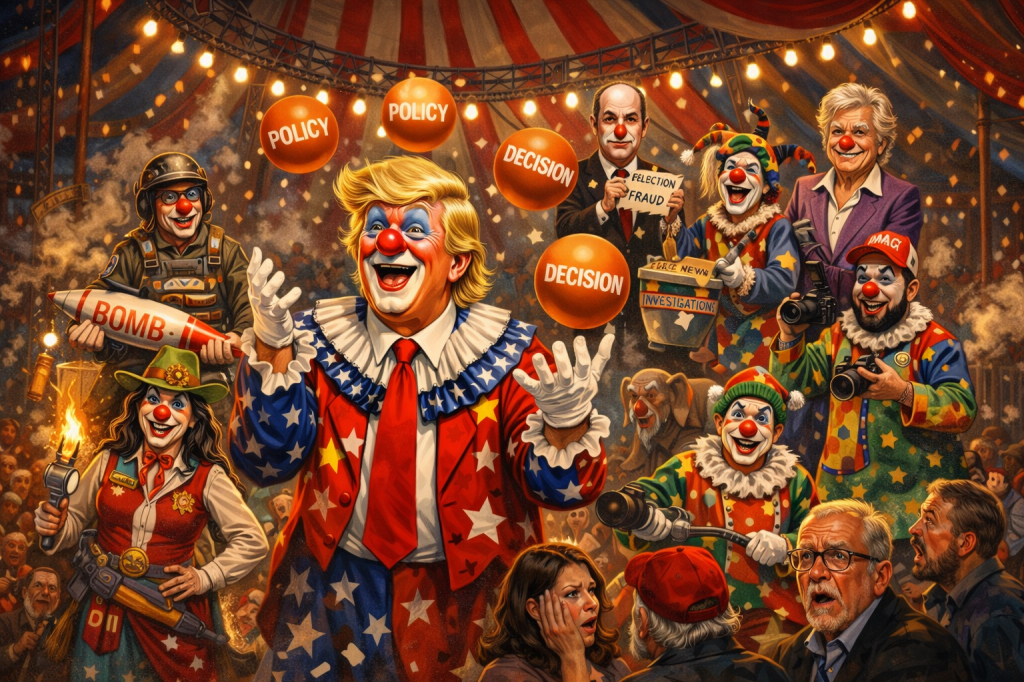
Critical accounts and investigations into the second administration of Donald Trump (2025–present) have centered on the prioritization of personal loyalty over institutional experience. Critics and political analysts have characterized the cabinet as a “clown car” or a “sycophantic” assembly, arguing that many key appointees lack the traditional qualifications, educational depth, or administrative experience required to lead massive federal bureaucracies.
General Critiques of Incompetence
A recurring theme in the 2025–2026 investigations is that the administration governs “by mistake” or through a “litany of blunders.” Observers such as former Labor Secretary Robert Reich argue that by replacing first-rate talent with “loyalist” figures, the administration has created a feedback loop of flattery that prevents objective decision-making.
Donald Trump – President of the United States
The core of the administration’s perceived incompetence stems from the President’s preference for personal fealty over institutional stability.
- The “Impulse Governance” Model: Analysts point to a series of contradictory executive orders issued in early 2025—specifically regarding tariffs—that caused immediate market volatility. Economists argue these were drafted without the input of the Treasury or Commerce departments, leading to “avoidable economic friction.”
- Knowledge Gaps: Congressional investigators have highlighted the President’s reported lack of interest in the “President’s Daily Brief,” leading to several instances where the administration was blindsided by geopolitical shifts in the Middle East and East Asia.
Linda McMahon – Secretary of Education
McMahon’s appointment was widely viewed as a “reward” for campaign donor loyalty rather than an endorsement of her educational expertise.
- Lack of Background: Having spent her career in professional wrestling (WWE) and a brief stint at the Small Business Administration, she possessed no professional background in pedagogy, student loan oversight, or public school administration.
- Operational Failure: Under her watch, the 2025–2026 FAFSA rollout faced technical collapses worse than those of previous years, which critics attribute to the purging of career civil servants who held the “institutional memory” of the department.
Robert F. Kennedy Jr. – Secretary of Health and Human Services (HHS)
RFK Jr.’s tenure is perhaps the most controversial, with critics labeling it a “war on science” led by a non-scientist.
- Anti-Science Rhetoric: His long history of questioning vaccine safety—despite overwhelming clinical evidence—led to a mass exodus of top researchers from the CDC and NIH in 2025.
- Institutional Destabilization: His “Make America Healthy Again” initiative was criticized for focusing on fringe nutritional theories while ignoring the logistical collapse of rural healthcare networks and the resurgence of preventable diseases like measles.
Pam Bondi – Attorney General
Bondi’s role as the nation’s top law enforcement officer has been framed by critics as the transformation of the DOJ into a “personal law firm” for the executive branch.
- Selective Prosecution: Investigations into the DOJ in 2026 suggest a pattern of “retributive justice,” where Bondi allegedly fast-tracked cases against political “enemies” while stalling investigations into administration allies.
- Extremist Alignment: Her past involvement in attempts to overturn the 2020 election results led many legal scholars to argue she lacks the impartial temperament required for the office.
Pete Hegseth – Secretary of Defense
Hegseth’s tenure has been one of the most scrutinized in modern history, marked by a lack of experience in managing large-scale organizations and allegations of personal misconduct.
- Experience & Education: A Princeton and Harvard graduate and former Army National Guard Major, Hegseth’s primary experience before the nomination was as a Fox News host. Critics argue this did not prepare him to lead the Department of Defense, an organization with nearly 3 million employees.
- Signalgate Scandal: In early 2025, an investigation by the DOD Inspector General found that Hegseth shared classified information regarding military strikes on Yemen via the insecure messaging app Signal. The messages reportedly included launch times for military jets, potentially endangering U.S. troops.
- Extremist Views: Hegseth has been linked to Christian Nationalist symbols, specifically his “Deus Vult” (God Wills It) tattoo, which resulted in him being flagged as an “insider threat” by the National Guard in 2021. He has also vocally opposed women in combat and pushed to purge “nonpartisan” generals from the military.
- Personal Conduct: His confirmation required a tie-breaking vote from Vice President JD Vance following hearings that addressed allegations of sexual misconduct, excessive drinking, and aggressive behavior.
Kristi Noem – Secretary of Homeland Security
Kristi Noem’s leadership at the Department of Homeland Security (DHS) has been defined by hardline stances and a series of public gaffes that have drawn accusations of incompetence.
- Background: A former Governor of South Dakota, Noem lacked significant federal or national security experience prior to her 2025 confirmation.
- The “Domestic Terrorism” Controversy: Noem faced severe backlash for labeling two U.S. citizens killed by federal agents as “domestic terrorists” before investigations were complete. Bystander videos later contradicted her account, leading to calls for her resignation.
- Lack of Diplomatic Standing: Her previous admission in her memoir to killing a family dog and her repeated conflicts with Native American tribes—who banned her from reservations in South Dakota—have been cited by critics as evidence of poor judgment and an inability to manage complex social and legal relationships.
Kash Patel – Director of the FBI
The confirmation of Kash Patel in February 2025 marked a radical shift in the Federal Bureau of Investigation, moving from an independent law enforcement agency to what critics describe as an “instrument of executive grievance.”
- Experience & Qualifications: Before becoming the 9th Director of the FBI, Patel’s primary executive experience consisted of a brief stint as Chief of Staff at the Department of Defense. Former National Security Advisor John Bolton and other high-ranking officials from the first Trump term publicly stated that Patel was “wholly unqualified” for such a massive administrative role, citing a lack of significant law enforcement leadership.
- The “Deep State” Purge: Upon taking office, Patel reportedly relocated up to 1,500 agents from the J. Edgar Hoover Building in Washington, D.C., and oversaw the dismissal of at least 10 high-ranking officials linked to past investigations of Donald Trump. Critics argue this “purge” has gutted the Bureau’s institutional memory and compromised its ability to track domestic extremist groups.
- “Signalgate” & Operational Security: In March 2025, Patel was embroiled in the “Signalgate” scandal alongside Pete Hegseth. Investigations revealed that top officials were using the insecure messaging app Signal on personal devices to discuss sensitive military strikes in Yemen. Senators labeled the move “sloppy” and “dangerous,” noting that such lapses in protocol could have cost American lives.
- Extremist Alignment: Patel has been criticized for his vocal support of January 6th defendants—whom he referred to as “hostages”—and for peddling QAnon-adjacent conspiracy theories on various podcasts. Experts from the Global Project Against Hate and Extremism warn that under Patel, the FBI has de-prioritized monitoring far-right accelerationist groups, leading to a resurgence of organizations like “The Base.”
- Personal Use of Government Assets: In early 2026, Patel faced intense scrutiny for his use of the FBI’s Gulfstream G550 jet. Reports emerged of the Director using the $60 million aircraft for personal trips, including an excursion to the Winter Olympics in Milan and a luxury hunting retreat. Ironically, Patel had been a fierce critic of taxpayer-funded travel by his predecessors before taking the job.
Summarized Findings: Administration-Wide Trends
The investigations into these figures reveal three consistent pillars of the 2025–2026 administration:
- Dismantling Expertise: Across the FBI (Patel), DHS (Noem), and HHS (Kennedy), career civil servants have been replaced by loyalists, leading to documented decreases in agency efficiency.
- Politicized Justice: The Department of Justice and FBI are frequently accused of “retributive justice,” prioritizing the investigation of political rivals over standard criminal or counter-terrorism priorities.
- Security Lapses: The frequent bypass of secure government communication channels (Signal/WhatsApp) by top cabinet members has created unprecedented vulnerabilities in national security.
Broader Administration Failures
The administration’s focus on “dismantling the deep state” has led to several operational breakdowns:
- Department of Education: Under Secretary Linda McMahon, the department faced intense criticism for “gross incompetence” regarding student aid and financial systems. Critics point to her lack of background in education policy as a primary factor in these failures.
- National Security Council (NSC): Reports indicated that activist Laura Loomer influenced the firing of multiple NSC staff members in 2025, suggesting that professional security expertise was being traded for ideological purity.
| Official | Position | Primary Criticism |
| Pete Hegseth | Defense | Lack of management experience; Signal security breach; Extremist ties. |
| Kristi Noem | Homeland Security | Controversial rhetoric on domestic incidents; Poor diplomatic relations. |
Comparative Analysis of Experience
| Official | Background | Major “Incompetence” Indicator |
| Robert Kennedy | Environmental Lawyer | Lack of medical degree; rejection of consensus science. |
| Linda McMahon | WWE Executive | Zero experience in public education or academia. |
| Pam Bondi | Prosecutor/Lobbyist | Accusations of using the DOJ for political retribution. |
| Stephen Miller | Political Advisor | Promotion of “Great Replacement” theory-adjacent policies. |
Stephen Miller – Deputy Chief of Staff for Policy
Miller is frequently cited as the architect of the administration’s most “extremist” and legally precarious maneuvers.
- Legal Overreach: Miller pushed for the use of military assets for domestic mass deportations, a move that several federal courts ruled unconstitutional in late 2025.
- Radical Views: Leaked internal memos authored by Miller reportedly utilized language associated with white nationalist “Great Replacement” theories to justify radical shifts in legal immigration quotas.
Karoline Leavitt – White House Press Secretary
At 27, Leavitt became the youngest Press Secretary in history. While technically proficient in media, her “incompetence” is cited in her inability to provide factual clarity.
- The “Post-Truth” Podium: Independent fact-checkers noted that during the first six months of 2025, Leavitt’s briefings contained a higher percentage of verifiable falsehoods than any of her predecessors.
- Experience Gap: Critics argue her background as a campaign spokesperson did not prepare her for the nuances of explaining complex foreign policy or national security crises, often leading to “word salad” responses that confused international allies.
Note on Investigations: Multiple House Oversight Committee reports from early 2026 suggest that the “brain drain” caused by these appointments has led to a 15% decrease in federal agency efficiency across the board.
 Canadian Country Life
Leave a comment