
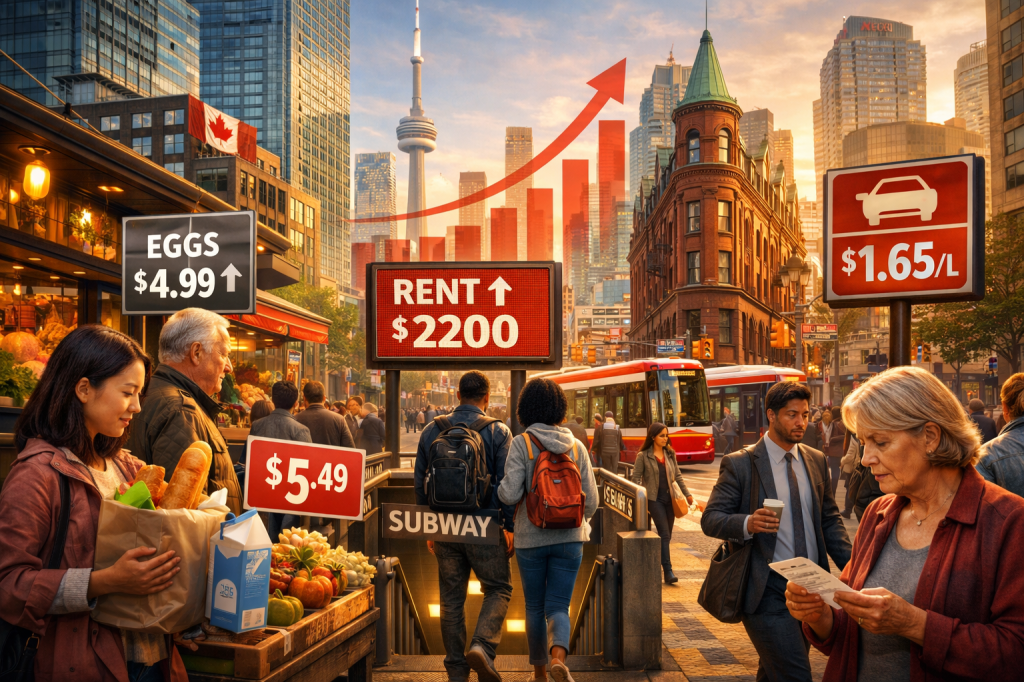
The Great White North Feels the Pinch: Navigating Canada’s Rising Cost of Living (2026 Edition)
In the year since Donald Trump’s return to the White House, the economic landscape for Canadians has shifted from “recovering” to “strained.” While the political drama unfolds in Washington, the real-world consequences are being felt at Canadian kitchen tables, gas pumps, and construction sites. A combination of aggressive trade tariffs and heightened geopolitical tensions—specifically involving Iran—has created a perfect storm for inflation.
Here is a detailed look at how these actions are hitting your wallet in 2026.
1. The Tariff War: A Tax on the Canadian Lifestyle
Early in 2025, the U.S. administration imposed a series of tariffs on Canadian goods, including a 25% levy on steel and aluminum and a 10% tariff on energy resources. Canada responded with its own retaliatory surtaxes on U.S. imports. The result? A direct hike in the price of almost everything that crosses the border.
Vehicles and Transportation
The automotive industry is perhaps the hardest hit due to its deeply integrated supply chain. Even vehicles “Made in Canada” often rely on American parts that are now subject to duties.
- New Vehicle Prices: The average price of a new SUV or sedan has jumped by an estimated $3,000 to $5,000 over the last year.
- Ownership Costs: Beyond the sticker price, maintenance is pricier. A set of tires or a simple brake rotor replacement has increased by roughly 15% because of the raw material tariffs on rubber and steel.
Building Materials and Housing
If you’re planning a renovation or looking for a new home, the “Trump Tax” is visible in every aisle of the hardware store.
- Lumber: With U.S. duties on softwood lumber hovering near 15%, the cost to frame a standard single-family home has increased by approximately $10,000.
- Fixtures and Hardware: Items like aluminum siding, steel roofing, and even brass plumbing fixtures have seen price spikes of 20% to 25% since the trade war intensified.
2. The Iran Conflict and the Energy Squeeze
The administration’s “maximum pressure” campaign and subsequent military escalations with Iran have sent global energy markets into a tailspin. While Canada is an oil producer, we are not immune to global “sticker shock.”
Gas Prices
Geopolitical instability in the Strait of Hormuz—a chokepoint for 20% of the world’s oil—has added a massive “risk premium” to every liter of fuel.
- At the Pump: In early March 2026, gas prices in parts of the Maritimes and Ontario have surged, with some regions seeing jumps of 10 to 12 cents per liter in a single week.
- Diesel: The lifeblood of the trucking industry, diesel has surpassed $2.00 per liter in several provinces. This creates a “hidden tax” on every physical good delivered by truck.
3. The Grocery Store: More Than Just Food
Food inflation in Canada is now being driven by a “triple threat”: high fuel costs for transport, tariffs on packaged goods, and the weakening of the Canadian dollar.
- The Annual Food Bill: Experts predict the average Canadian family of four will spend nearly $17,600 on groceries in 2026—an increase of almost $1,000 compared to last year.
- Imported Produce: During the winter months, Canada relies on the U.S. and Mexico. A head of lettuce that cost $3.50 two years ago is frequently spotted at $5.99 or higher.
- Proteins and Staples: * Ground Beef: Now averaging over $15.00/kg.
- Milk (2L): Pushing toward $5.50 in many urban centers.
- Bread: A standard loaf has climbed to roughly $3.60.
4. The “Loonie” Factor
Trade uncertainty often causes investors to flock to the U.S. dollar, leaving the Canadian dollar (the “Loonie”) struggling. As our currency weakens, our buying power for anything imported—from iPhones to oranges—drops significantly. This currency depreciation acts as an invisible 5-10% price increase on top of the existing tariffs.
Summary of Price Changes (Estimated 2024 vs. 2026)
| Item | Estimated Price (2024) | Estimated Price (March 2026) |
| Gasoline (National Avg) | $1.50/L | $1.65 – $1.80/L |
| Ground Beef (1kg) | $11.50 | $15.30+ |
| New Compact SUV | $36,000 | $41,000 |
| 2×4 Lumber (8ft) | $5.50 | $7.25 |
| Dozen Eggs | $3.90 | $4.75 |
The Bottom Line
Canada finds itself in a defensive crouch. While the Bank of Canada has attempted to manage the situation by adjusting interest rates, they cannot control U.S. trade policy or Middle Eastern conflicts. For the average Canadian, 2026 is a year of “substitution”—trading beef for lentils, driving less, and delaying the dream of a new home.
Would you like me to help you create a monthly budget plan or a list of “Buy Canadian” alternatives to help mitigate these rising costs?
 Canadian Country Life
Leave a comment