
Introduction
The story of Canada is a complex and fascinating journey that stretches back thousands of years. Long before European explorers arrived, the land was already home to thriving Indigenous civilizations that developed sophisticated cultures, trade networks, and systems of governance. Over centuries, waves of exploration, colonization, settlement, land development, and immigration transformed the northern half of North America into the country known today as Canada.
Understanding how Canada was formed requires exploring the interactions between Indigenous peoples, European settlers, governments, and immigrants who shaped the country’s development. From the earliest First Nations communities to modern multicultural cities, Canada’s identity has been built through cooperation, conflict, adaptation, and growth.
This article explores the full history of how Canada developed—from the Indigenous nations who first inhabited the land to the formation of a unified country and the diverse society that exists today.
Indigenous Peoples: The First Inhabitants of Canada
Long before the creation of Canada as a political nation, the land was inhabited by Indigenous peoples for more than 15,000 years. These societies developed unique cultures deeply connected to the land and environment.
Three primary Indigenous groups exist in Canada today:
- First Nations
- Inuit
- Métis
First Nations communities lived across most of the southern regions of what is now Canada. Each nation had its own language, traditions, and governance structures. For example, some nations built permanent villages with longhouses, while others lived more nomadic lifestyles following seasonal hunting patterns.
In the Arctic regions, the Inuit adapted to one of the harshest environments on Earth. Their survival depended on advanced knowledge of sea ice, wildlife, and seasonal migration patterns.
The Métis people emerged later as a distinct culture through relationships between Indigenous peoples and European fur traders.
Indigenous societies maintained extensive trade networks across North America long before Europeans arrived. Goods such as copper, obsidian, shells, and furs were exchanged across thousands of kilometers.
Equally important was Indigenous knowledge of the land. Their deep understanding of ecosystems, rivers, forests, and wildlife allowed communities to thrive in environments ranging from coastal rainforests to arctic tundra.
This knowledge would later prove essential for the survival of European explorers and settlers.
Early European Exploration
European contact with northern North America began around the year 1000 when Norse explorers established a small settlement at L’Anse aux Meadows. Although the settlement did not last long, it represents the earliest known European presence in Canada.
Centuries later, exploration resumed during the age of maritime expansion.
In 1534, French explorer Jacques Cartier sailed into the Gulf of St. Lawrence and claimed the land for France. His voyages opened the door for further exploration and colonization.
Later, Samuel de Champlain founded Quebec City in 1608. This settlement became the heart of the French colony known as New France.
Unlike later large-scale settlements, early European presence in Canada was relatively small. Instead, the economy centered on the fur trade, particularly beaver pelts used to make fashionable hats in Europe.
French traders developed strong alliances with Indigenous nations, relying on them for transportation, hunting expertise, and trade connections.
The Fur Trade and Expansion Into the Interior
The fur trade shaped the development of Canada more than almost any other early industry.
Two major trading organizations dominated the trade:
- Hudson’s Bay Company
- North West Company
Founded in 1670, the Hudson’s Bay Company controlled a vast territory known as Rupert’s Land, which covered much of modern Canada. The company established trading posts along rivers and lakes where Indigenous trappers exchanged furs for European goods such as metal tools, firearms, and textiles.
These trading networks expanded European influence deep into the interior of the continent.
Travel across the Canadian wilderness relied heavily on canoe routes and river systems, which served as the highways of early North America.
French voyageurs and Métis traders became legendary figures in Canadian history, transporting goods across enormous distances through forests, lakes, and rivers.
British Rule and the Division of Land
In 1763, the balance of power in North America changed dramatically after the Seven Years’ War.
France ceded much of its North American territory to Britain, and the region became known as British North America.
British administrators began reorganizing the territory for governance and settlement.
A major migration occurred following the American Revolutionary War when tens of thousands of Loyalists—colonists who remained loyal to Britain—moved north into British territories.
To manage population growth, the British government divided land into structured settlements.
Two important colonies were created:
- Upper Canada (modern Ontario)
- Lower Canada (modern Quebec)
Surveyors mapped the land into townships and concession lots, which settlers could claim and farm.
Clearing the Land and Building Farms
Early settlers faced enormous challenges when establishing farms.
Much of eastern Canada was covered in dense forests. Clearing land required cutting down massive trees using axes and saws. Trees were often burned to create fields suitable for crops.
Typical homestead development followed several steps:
- Building a log cabin
- Clearing forested land
- Planting crops such as wheat, corn, and barley
- Establishing livestock and gardens
Over time, rural communities formed around mills, churches, and trading centers.
Agriculture became one of the most important foundations of Canadian economic development.
Confederation: The Birth of Canada
By the mid-1800s, several British colonies in North America began discussing political union.
There were several reasons for this:
- Economic cooperation between colonies
- Defense concerns related to the United States
- Infrastructure projects like railways
- Political stability
On July 1, 1867, the Canadian Confederation created the Dominion of Canada.
The original provinces were:
- Ontario
- Quebec
- Nova Scotia
- New Brunswick
Over time, additional regions joined the country, expanding Canada westward.
Building the Nation: Railways and Expansion
One of the most ambitious projects in Canadian history was the construction of the Canadian Pacific Railway.
Completed in 1885, the railway connected eastern Canada to the Pacific coast.
This massive infrastructure project helped:
- Encourage settlement in western Canada
- Facilitate trade across the country
- Strengthen national unity
The railway also relied heavily on immigrant labor, including thousands of Chinese workers who faced extremely dangerous working conditions.
Immigration and Population Growth
Canada’s population expanded dramatically through immigration in the late 19th and early 20th centuries.
The government actively encouraged immigrants to settle the Prairies.
Major immigrant groups came from:
- Britain
- Ireland
- Ukraine
- Germany
- Scandinavia
- Italy
- China
- Eastern Europe
These settlers transformed the Prairie provinces into one of the world’s largest agricultural regions.
Cities such as Toronto, Montreal, and Vancouver became major centers of commerce, industry, and immigration.
Canada Today: A Multicultural Nation
Modern Canada is recognized globally for its multicultural population and democratic institutions.
Today the country consists of 10 provinces and 3 territories stretching from the Atlantic Ocean to the Pacific and north into the Arctic.
Canada’s identity reflects a combination of:
- Indigenous heritage
- French and British colonial roots
- Global immigration
In recent decades, Canada has also focused on reconciliation with Indigenous peoples and recognizing the impacts of historical policies.
Conclusion
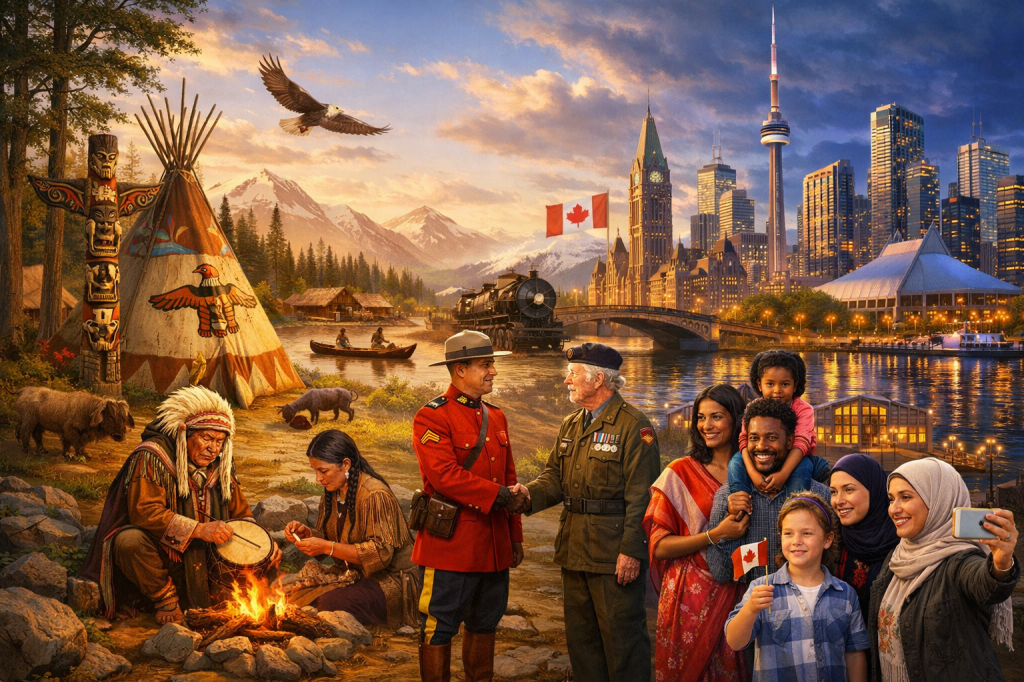
Canada’s formation was not a single moment but a long process shaped by many cultures and communities.
Indigenous nations lived on and cared for the land for thousands of years before European arrival. Explorers and settlers brought new systems of government and land use. Farmers cleared forests and built towns. Railways connected distant regions. Immigrants from across the globe added languages, traditions, and skills that helped shape the nation.
Today, Canada stands as one of the world’s most diverse and geographically vast countries—built through centuries of cooperation, migration, development, and resilience.
 Canadian Country Life
Leave a comment