
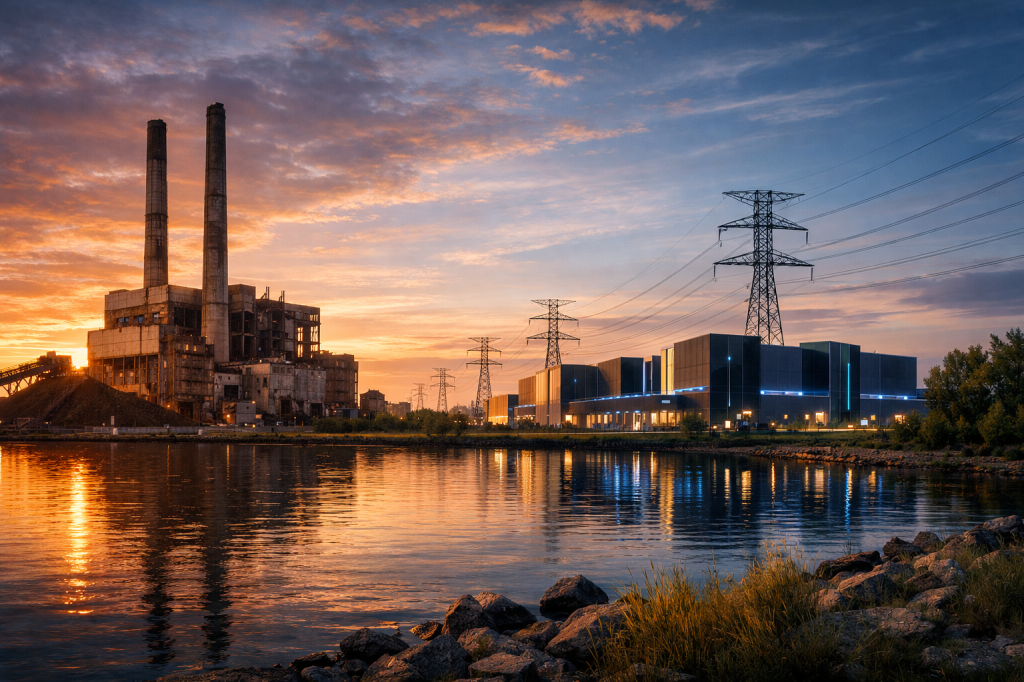
For decades, the Lambton Generating Station stood as one of Ontario’s most recognizable energy landmarks. Its towering smokestacks along the St. Clair River once symbolized the province’s industrial strength and ability to generate large amounts of electricity.
When the plant closed in 2013 as part of Ontario’s move away from coal-fired power, it marked the end of an era. The massive site has largely sat quiet since then, leaving many in the region wondering what its next chapter might be.
Now, a new possibility has emerged: transforming the former coal plant site into a large-scale data centre. If it happens, the site that once powered homes and factories could soon power something entirely different—the digital economy.
Why the Site Makes Sense for a Data Centre
At first glance, an old coal power station might seem like an unlikely location for modern digital infrastructure. In reality, it may actually be one of the best places possible.
Existing Power Infrastructure
Data centres require enormous amounts of electricity. One of the biggest challenges in building them is gaining access to reliable high-capacity power connections.
The Lambton site already has exactly that.
It was originally designed to deliver massive amounts of electricity to the provincial grid. The transmission lines, substations, and industrial electrical infrastructure already exist, which removes one of the biggest obstacles to building a major data facility.
Large Industrial Footprint
The property is vast, covering more than a thousand acres of industrial land. That provides plenty of space for server buildings, cooling systems, backup power, and potential expansion in the future.
Very few sites in Ontario offer that kind of scale.
Strategic Location
Lambton County sits in a unique industrial corridor near the U.S. border and within reach of major population centers in Ontario and the American Midwest.
The region already has strong energy infrastructure, including pipelines, power transmission, and industrial utilities—things that modern data facilities depend on.
The Potential Benefits for Lambton County
If the project moves forward, it could bring several major advantages to the region.
1. Economic Investment
Large data centres require enormous upfront investment. Construction alone could bring hundreds of millions—or even billions—of dollars into the local economy.
That spending would benefit construction companies, contractors, engineers, and many other businesses throughout southwestern Ontario.
2. A New Type of Industry
Sarnia–Lambton has long been known for petrochemicals, refining, and heavy industry. A major data centre could introduce an entirely new sector to the region.
Instead of processing oil and chemicals, the area could also become part of the global digital infrastructure network.
3. Reusing a Historic Industrial Site
Redeveloping the former coal plant would prevent a massive industrial property from sitting unused.
Turning an old energy facility into something modern and productive could represent a successful example of industrial reinvention.
4. Increased Local Tax Revenue
Facilities of this size generate significant property tax revenue. That money can support local services, infrastructure improvements, and community projects.
For municipalities, large infrastructure developments can provide long-term financial stability.
The Possible Downsides
While the idea has potential, there are also important questions to consider.
1. Limited Permanent Employment
Unlike factories or refineries, data centres typically employ relatively small operational teams once construction is complete.
While the building phase could create many jobs, long-term employment numbers might be modest compared to traditional manufacturing projects.
2. Enormous Electricity Demand
Modern data centres—especially those used for artificial intelligence computing—consume staggering amounts of electricity.
A single facility can use as much power as a small city.
That raises questions about how Ontario’s electricity grid will handle growing demand and whether new power generation will be required.
3. Environmental Considerations
Even though data centres are part of the digital economy, they still have environmental impacts.
Cooling systems can require large amounts of water and electricity. If additional natural gas generation is needed to support the facility, some critics may question whether the environmental trade-off is worthwhile.
4. Opportunity Cost
Some people may argue that such a large industrial property could be used for other economic opportunities—such as advanced manufacturing, hydrogen production, or clean energy projects.
Choosing one path may limit others.
A Powerful Symbol of Economic Transition
Perhaps the most interesting aspect of this proposal is what it represents.
For decades, Lambton Generating Station symbolized the energy economy of the 20th century—coal, heavy industry, and large-scale power production.
A data centre would represent the digital economy of the 21st century—artificial intelligence, cloud computing, and global data networks.
In a sense, the site could evolve from generating electricity for factories to supporting the infrastructure that powers modern technology.
The smokestacks that once defined the skyline might eventually give way to rows of server buildings quietly running the digital world.
The Future of the Site
At this stage, the idea remains just that—an idea. Projects of this scale take years of planning, investment, and approvals before construction can begin.
But the concept itself reflects a broader trend happening across North America: old industrial sites are being repurposed to support the technologies shaping the future.
If the transformation happens, the Lambton site may once again become one of the most important pieces of infrastructure in the region—just in a completely different way.
The Global Data Centre Boom
Across the world, data centres are becoming some of the most important pieces of modern infrastructure. Every time someone streams a movie, stores photos in the cloud, or uses artificial intelligence tools, the information is processed in massive server facilities.
The rise of artificial intelligence is accelerating this trend dramatically. AI computing requires enormous processing power, and that power is housed in data centres that can consume vast amounts of electricity.
Countries that attract these facilities often gain long-term advantages in the technology economy. Regions with reliable energy, land availability, and strong infrastructure are increasingly competing to host them.
This is where the Lambton site becomes interesting.
Few locations in Canada combine industrial land, grid connectivity, and proximity to energy infrastructure the way Lambton County does.
What once made the area ideal for heavy industry may now make it ideal for digital infrastructure.
Why Old Power Plant Sites Are Being Repurposed
The potential redevelopment of the Lambton Generating Station is part of a broader global trend.
Many retired power plant sites are being converted into new forms of infrastructure.
There are several reasons why:
Power Access
Large data centres need enormous electrical connections. Former power plants already have high-capacity transmission infrastructure in place.
Industrial Zoning
These sites are already approved for heavy industrial use, which makes permitting easier.
Available Land
Power stations were often built on large parcels of land, leaving room for redevelopment.
Grid Connectivity
Existing substations and grid links reduce construction costs dramatically.
For developers, this can save years of planning and millions in infrastructure investment.
What a Large Data Centre Actually Looks Like
Many people imagine data centres as small server rooms. In reality, modern facilities are enormous.
A single hyperscale data centre can include:
- Multiple warehouse-sized buildings
- Tens of thousands of servers
- Backup power generators
- Advanced cooling systems
- Security infrastructure
- Electrical substations
Inside the buildings are rows of server racks processing data continuously.
These facilities operate 24 hours a day, 365 days a year, making reliability one of their most important requirements.
That constant demand for electricity is one of the reasons developers are drawn to locations with strong power infrastructure like the Lambton site.
What It Could Mean for the Region
If a data centre were built near Sarnia and within Lambton County, the economic impact could reach beyond the immediate site.
Construction alone could last several years and involve:
- electrical contractors
- construction firms
- engineers
- transportation companies
- equipment suppliers
Hotels, restaurants, and local businesses would likely see increased activity during the development phase.
Long term, the presence of digital infrastructure could also attract other industries that rely on high-capacity data networks.
This might include technology companies, research facilities, or advanced manufacturing operations that rely on high-performance computing.
The Energy Question
The biggest challenge facing large data centre projects is electricity demand.
Artificial intelligence computing in particular requires enormous processing power. Some large facilities consume as much electricity as small cities.
This raises an important question for regions considering these developments:
Where will the power come from?
If electricity demand increases significantly, it may require:
- new power generation
- expanded grid capacity
- improved transmission infrastructure
Balancing economic growth with energy supply will be one of the key decisions surrounding projects like this.
The Symbolism of the Site
There is also something symbolic about the potential transformation of the Lambton facility.
For decades the plant represented a very different era of energy.
Coal-fired electricity powered factories, industries, and the economic expansion of the late twentieth century.
If the site becomes a data centre, the energy flowing through those transmission lines will still power the economy—but in a completely different way.
Instead of manufacturing and heavy industry, it will support:
- cloud computing
- artificial intelligence
- digital communication
- global data networks
In many ways, the site could represent the transition from Canada’s industrial economy to its digital one.
Final Thoughts
The future of the Lambton Generating Station site remains uncertain, but the idea of converting it into a major data centre highlights how quickly the global economy is changing.
Places once built to generate electricity for industry may soon become the foundations of the digital infrastructure that powers modern life.
If the project moves forward, Lambton County could once again become an important part of the energy story in Ontario—this time powering the servers and networks that drive the information age.
 Canadian Country Life
Leave a comment