
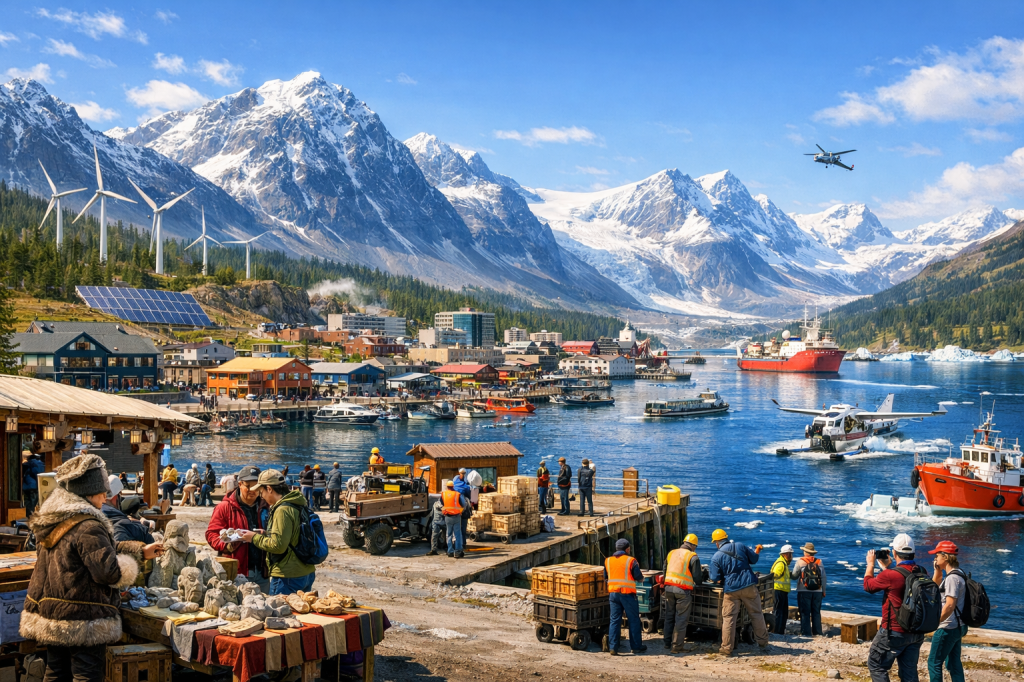
Northern Canada: The Untapped Economic Giant
For decades, the Canadian North was viewed through a lens of romanticized isolation—a vast expanse of ice, tundra, and potential that always seemed “just over the horizon.”
But as we move through 2026, that narrative has shifted. No longer just a remote frontier, Northern Canada is emerging as a central pillar of the global economy. Driven by the urgent demand for critical minerals, a revolution in Indigenous-led development, and a massive federal “nation-building” push, the North is finally waking up.
The Critical Mineral Gold Rush
The global transition to green energy has put a spotlight on the North’s geological wealth. From the Yukon to Nunavut, the region holds the “ingredients” for the 21st century: copper, lithium, nickel, and rare earth elements.
- The Ring of Fire: In Northern Ontario, the provincial government recently accelerated plans for all-season roads into the mineral-rich Ring of Fire, with construction slated for June 2026. This project alone is projected to add $22 billion to the economy.
- The Critical Minerals Sovereign Fund: A new $2 billion federal fund is now actively making equity investments in northern projects to ensure Canada doesn’t just mine these resources but processes them domestically.
- A Global Partner: In March 2026, Canada secured over $12 billion in new mining capital through partnerships with 12 allied nations, cementing the North as a secure alternative to volatile global supply chains.
Breaking the “Infrastructure Gap”
You can’t run a modern economy on winter roads and satellite pings alone. The biggest barrier to the North’s growth has always been the “infrastructure deficit.” That is changing with several “nation-building” projects now in motion:
- The Mackenzie Valley Highway: An 800 km artery that will finally connect Yellowknife to Inuvik year-round, slashing travel times and stabilizing the cost of living for remote communities.
- Grays Bay Road and Port: This project will create Nunavut’s first overland connection to a deepwater port on the Arctic Ocean, linking strategic copper and gold deposits directly to global markets.
- The Taltson Hydro Expansion: Doubling the hydro capacity of the Northwest Territories, this project is designed to replace expensive diesel with clean power for both residents and industrial mines.
A New Model: Indigenous-Led Prosperity
Perhaps the most significant shift in 2026 isn’t what is being built, but how. The days of “extraction without representation” are over.
Economic reconciliation is now the primary engine of northern growth. We are seeing a surge in Indigenous-led exploration, such as the Tłı̨chǫ Government’s recent $1.5 million mineral initiative. Projects like the Arctic Economic and Security Corridor are being driven by partnerships between First Nations, Inuit governments, and territorial leaders. This ensures that the wealth generated stays in the North, funding housing, education, and local businesses.
“True reconciliation requires the resources to make that happen. We are laying the groundwork for sustainable, Indigenous-led prosperity.” — Chief Bruce Achneepineskum, Marten Falls First Nation.
The Bottom Line
Northern Canada is no longer a “sleeping giant.” With $40 billion in planned federal investments and a strategic role in the global energy transition, the region is becoming a cornerstone of national security and economic strength. The challenges—permafrost thaw, extreme weather, and high costs—remain, but the momentum is undeniable.
The North isn’t just a place on the map anymore; it’s the future of the Canadian economy.
 Canadian Country Life
Leave a comment