
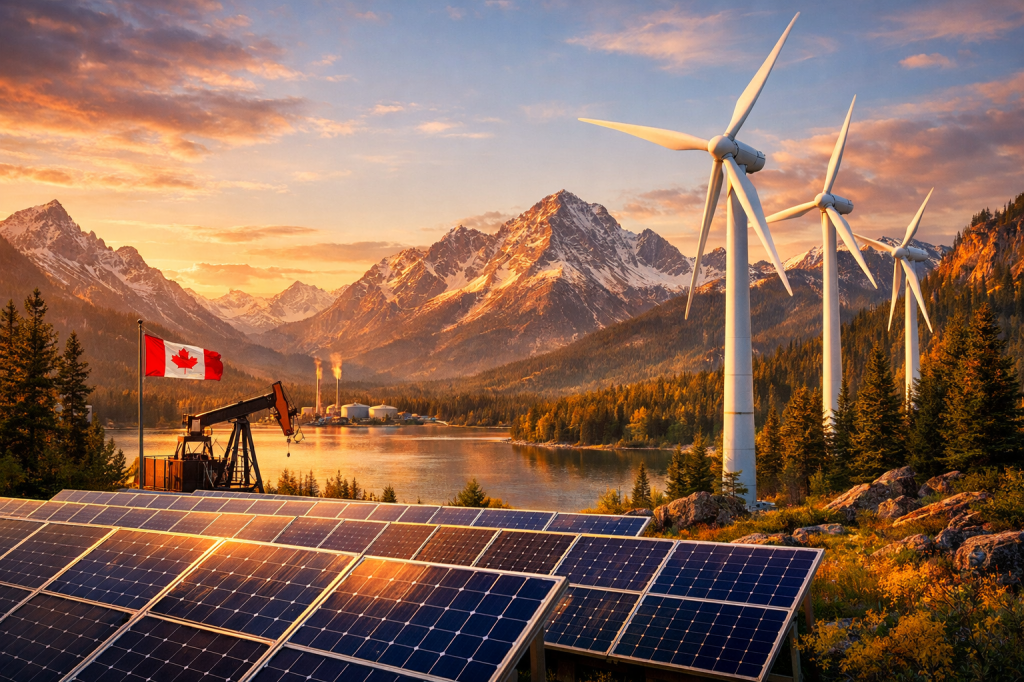
The North Star: How Canada Could Become the World’s Energy Superpower
For decades, the phrase “energy superpower” has been tossed around Canadian politics like a hockey puck in a corner scrum. But in 2026, the global landscape has shifted. With the “Age of Electricity” in full swing and geopolitical tensions pushing energy security to the top of every nation’s priority list, the title is no longer just a tagline—it is a tangible, multi-trillion-dollar opportunity.
Canada isn’t just an oil-and-gas player anymore; it is a diversified energy giant in waiting. Here is how Canada can finally claim its seat at the head of the global energy table.
1. The Critical Minerals Gold Rush
The world’s transition to net-zero is literally built on Canadian soil. From electric vehicle (EV) batteries to wind turbines, the “green” economy requires massive amounts of lithium, cobalt, nickel, and copper.
- The Advantage: Canada is one of the few Western nations with significant reserves of all the minerals required for EV batteries.
- The 2026 Shift: With the new Western Canadian Critical Minerals Strategy, provinces are finally aligning infrastructure to move these resources from remote northern regions to global markets.
- The Goal: Moving from being a “hewer of wood” to a “processor of power.” By refining these minerals domestically, Canada can anchor the entire North American battery supply chain.
2. Leading the Small Modular Reactor (SMR) Revolution
While the world debates the future of nuclear, Canada has quietly become a global laboratory for Small Modular Reactors.
“SMRs aren’t just for the grid; they are the key to decarbonizing heavy industry.”
Ontario is leading the charge with its nuclear expansion, but the real “superpower” move is exporting this technology. Countries like Poland are already looking to Canadian expertise to build their own nuclear futures. By mastering the deployment of SMRs to power remote mines and oil sands operations, Canada creates a blueprint for industrial decarbonization that the rest of the world is desperate to buy.
3. The Hydrogen and LNG “Bridge”
Global energy demand is projected to grow by 3.6% annually through 2030. While renewables are the future, the world still needs reliable, lower-carbon transition fuels today.
- LNG to Asia: With the Trans Mountain expansion and new LNG terminals, Canada is finally breaking its “landlocked” status, providing a cleaner alternative to coal for giants like India and Southeast Asia.
- The Hydrogen Frontier: Canada is already a top-10 hydrogen producer. By leveraging its vast natural gas reserves (with carbon capture) and its massive hydroelectric capacity, Canada can export “blue” and “green” hydrogen to energy-hungry markets in Europe and Asia.
4. Electricity: The New Export Commodity
Canada is the world’s third-largest producer of hydroelectricity. In a 2026 economy where AI data centers and advanced manufacturing are thirstier for power than ever, “clean electrons” are the ultimate currency.
The vision is a truly interconnected national grid. By building the “Saskatchewan North–South” and “Eastern Energy” interties, Canada can move surplus clean power across borders—both provincial and international—acting as the “green battery” for the entire North American continent.
The Path Forward: Abundance Over Scarcity
Becoming a superpower requires more than just resources; it requires speed. The federal government’s commitment to a “maximum two-year timeframe” for project approvals is a start, but the real test lies in execution.
If Canada can bridge the gap between its resource-rich provinces and its net-zero ambitions, it won’t just be an energy participant—it will be the indispensable partner that the 21st-century global economy cannot live without.
 Canadian Country Life
Leave a comment