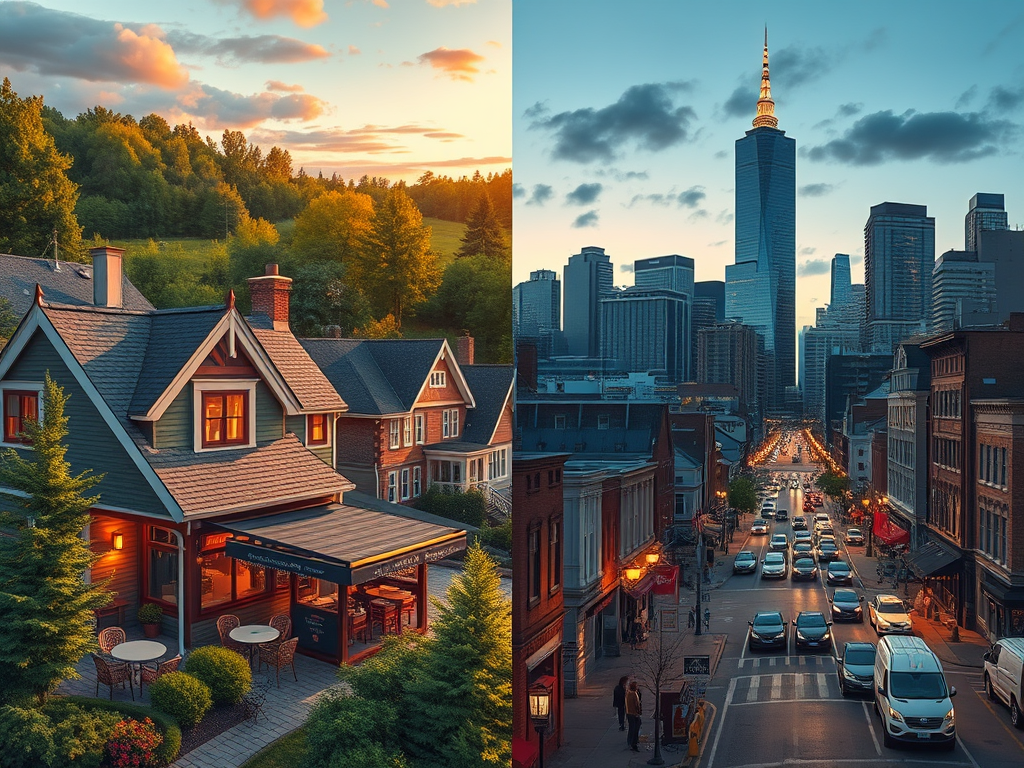
Moving across Canada is often a choice between two distinct worlds: the high-octane, sky-scraping energy of the “Big Three” (Toronto, Vancouver, Montreal) and the quiet, community-driven life of the “True North” small towns.
As we move through 2026, the gap between these lifestyles is changing. Remote work has matured, and the “Great Urban Reset” has reshaped how we think about where we live. Here is the breakdown of Small Town vs. Big City Canada in 2026.
1. The Cost of Living: Beyond the Rent
It’s no secret that the “Big City” comes with a big price tag. In 2026, a one-bedroom in downtown Toronto or Vancouver consistently hovers around $2,500/month.
In contrast, small-town Canada offers a significant “breathing room” for your wallet. In places like Moncton, New Brunswick, or Thunder Bay, Ontario, you can still find rents for roughly $1,100–$1,500. However, there’s a hidden trade-off: Car Dependency.
- Big City: High rent, but you can live car-free with robust transit (like the TTC or Montreal’s REM).
- Small Town: Low rent, but a vehicle is a non-negotiable expense. Gas prices in 2026 average $1.40–$1.85/litre, which can quickly eat up those rent savings.
2. Community: “Anonymous” vs. “Known”
One of the most profound differences is your social “visibility.”
- The Big City (Anonymity): In a city of millions, you have the freedom to be whoever you want. You can disappear into a crowd at a festival or find a niche community for even the rarest hobbies. However, this can lead to “urban loneliness”—living in a building with 500 people and not knowing a single neighbor.
- The Small Town (Visibility): Here, you are a “regular.” People know your name at the local coffee shop, and neighbors look out for one another. The downside? The “fishbowl effect.” Privacy is harder to come by, and local gossip is the unofficial town pastime.
3. Career and Opportunity
The professional landscape in 2026 is no longer strictly “office-bound,” but geography still matters.
- The Big City: Remains the hub for specialized sectors like Finance, Tech, and the Arts. If you want to climb a corporate ladder or network with global leaders, the density of a big city is an unmatched catalyst.
- The Small Town: Excellent for “essential” professionals—healthcare workers, tradespeople, and teachers are in desperate demand in rural Canada. It’s also the new frontier for the “Zoom Town” resident—remote workers who bring a Toronto salary to a town of 5,000.
4. Quality of Life: Speed vs. Stillness
This is usually the “dealbreaker” for most Canadians.
| Feature | Big City (e.g., Vancouver/Montreal) | Small Town (e.g., Stratford/Nelson) |
| Pace | Fast-moving, 24/7 energy. | Slower, dictated by seasons. |
| Amenities | World-class hospitals, diverse dining. | Limited medical facilities, fewer shops. |
| Nature | Manicured parks, “planned” green space. | Instant access to lakes, trails, and stars. |
| Commute | 45+ minutes (often on transit/traffic). | 10–15 minutes (usually a simple drive). |
Which is right for you in 2026?
The “winner” depends on your current stage of life. We are seeing a 2026 trend where mid-sized cities (like Ottawa, Halifax, or Quebec City) are becoming the “Goldilocks” choice—offering urban amenities with a small-town sense of safety and slightly better affordability.
If you crave the neon lights and the next big thing, the city is calling. But if you want to see the Milky Way from your backyard and know your mail carrier by name, the small town is waiting.
 Canadian Country Life
Leave a comment