
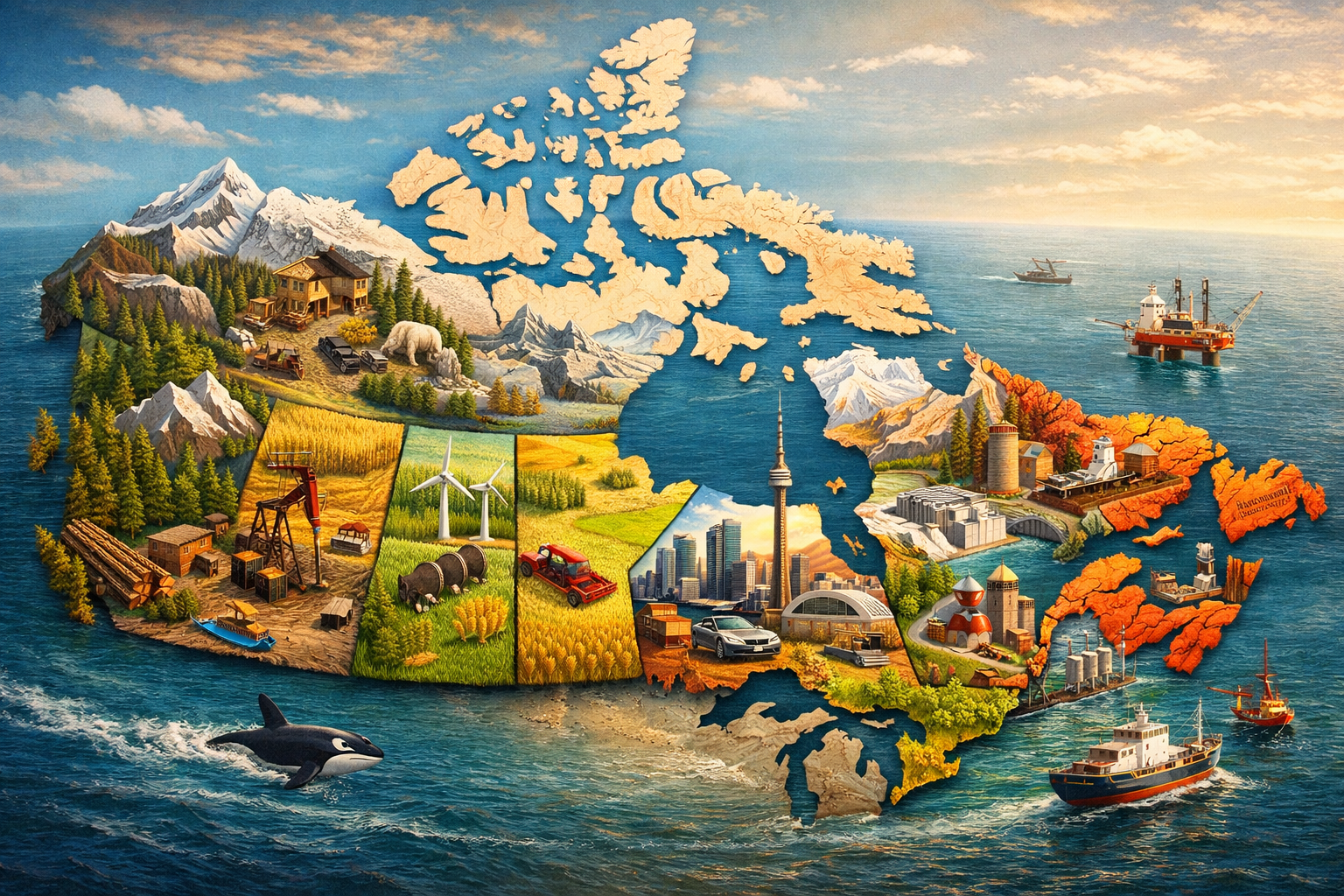
The Great Canadian Patchwork: Why Every Province is an Economic World of Its Own
If you look at Canada’s national GDP, you’re only seeing the tip of the iceberg. Beneath the surface, the Canadian economy is a fascinating, fragmented collection of regional powerhouses. As of 2026, the “average” Canadian experience doesn’t really exist; instead, we have a country where one province might be riding a commodity super-cycle while another navigates a manufacturing pivot.
From the tech towers of Toronto to the offshore rigs of Newfoundland, here is why each province remains economically unique.
The Resource Titans: Alberta, Saskatchewan, and Newfoundland
These provinces are the engines of Canada’s primary sector. Their fortunes are often tied to global “shocks”—most recently the 2026 spike in oil prices due to geopolitical instability in the Middle East.
- Alberta: Still the heavyweight of oil and gas, Alberta has leveraged new pipeline capacity (like the Trans Mountain expansion) to reach record production levels. However, it’s also quietly becoming a leader in renewable energy, particularly wind and solar.
- Saskatchewan: Often called “the world’s breadbasket,” its economy is a trifecta of essentials: food (wheat/canola), fuel (uranium), and fertilizer (potash). It is currently benefiting from major new mining projects that are among the most sustainable in the world.
- Newfoundland and Labrador: This is the most volatile of the bunch. Its economy swings on offshore oil and iron ore. While it faces high unemployment, the 2026 oil price surge has provided a critical fiscal lifeline.
The Industrial Heartlands: Ontario and Quebec
If the Prairies provide the raw materials, Central Canada provides the “value-add.” These two provinces represent over half of Canada’s population and are the most sensitive to trade relations with the United States.
- Ontario: The financial and manufacturing hub. While its tech and finance sectors in Toronto remain global players, its massive auto industry is currently in a high-stakes transition toward electric vehicle (EV) and battery manufacturing.
- Quebec: Quebec is the king of hydroelectric power, which gives it a massive “green” advantage for energy-intensive industries. It also dominates in aerospace and has carved out a world-leading niche in Artificial Intelligence (AI) and video game development.
The Gateway and the Forest: British Columbia
B.C. is an economic hybrid. It functions as Canada’s “Pacific Gateway,” with the Port of Vancouver serving as the primary link to Asian markets.
- Key Drivers: Historically built on forestry and mining, B.C.’s modern economy is heavily driven by real estate, tourism, and a burgeoning tech sector.
- Current State: In 2026, B.C. is navigating a cooling housing market and shifting demographics, but its role in Liquefied Natural Gas (LNG) exports is becoming a more prominent pillar of its growth.
The Diversifying Atlantic: NS, NB, and PEI
Long reliant on traditional industries like fishing and forestry, the Maritimes are undergoing a quiet transformation.
- Nova Scotia: Growing rapidly through “ocean tech” and a massive boom in the export of education (international students) and seafood.
- New Brunswick: A manufacturing-heavy Atlantic province with strong ties to forestry and energy refining, now focusing on green energy and marine logistics.
- Prince Edward Island: Small but mighty, its economy is anchored by the “three F’s”: Farming (potatoes), Fishing, and ‘Federation’ (tourism). It consistently boasts some of the most stable growth in the region.
The Diversified Prairie: Manitoba
Manitoba is often the “steady Eddie” of the Canadian economy. Unlike its neighbors, it isn’t overly dependent on a single commodity. It has a balanced mix of agriculture, manufacturing (notably buses and aerospace), and clean hydroelectric power, making it one of the most resilient provinces during economic downturns.
Summary Table: Provincial Economic Profiles (2026)
| Province | Primary Economic Driver | 2026 Growth Outlook |
| Alberta | Oil, Gas, & Renewables | High (Leading the nation) |
| Ontario | Finance, Tech, & Auto | Moderate (Trade sensitive) |
| Quebec | Hydro, Aerospace, & AI | Moderate (Energy-advantaged) |
| Saskatchewan | Potash, Uranium, & Wheat | High (Commodity boom) |
| B.C. | Real Estate, Tech, & LNG | Cautious (Housing headwinds) |
| Atlantic Canada | Fisheries, Tourism, & Energy | Improving (Trade recovery) |
Why This Diversity Matters
This “fragmentation” is actually Canada’s greatest strength. When manufacturing in Ontario slows down, high oil prices in the West often pick up the slack. When global food demand spikes, the Prairies shine.
What do you think? Does your province’s local economy feel like it matches the national headlines, or are you seeing something different on the ground?
Leave a Reply