
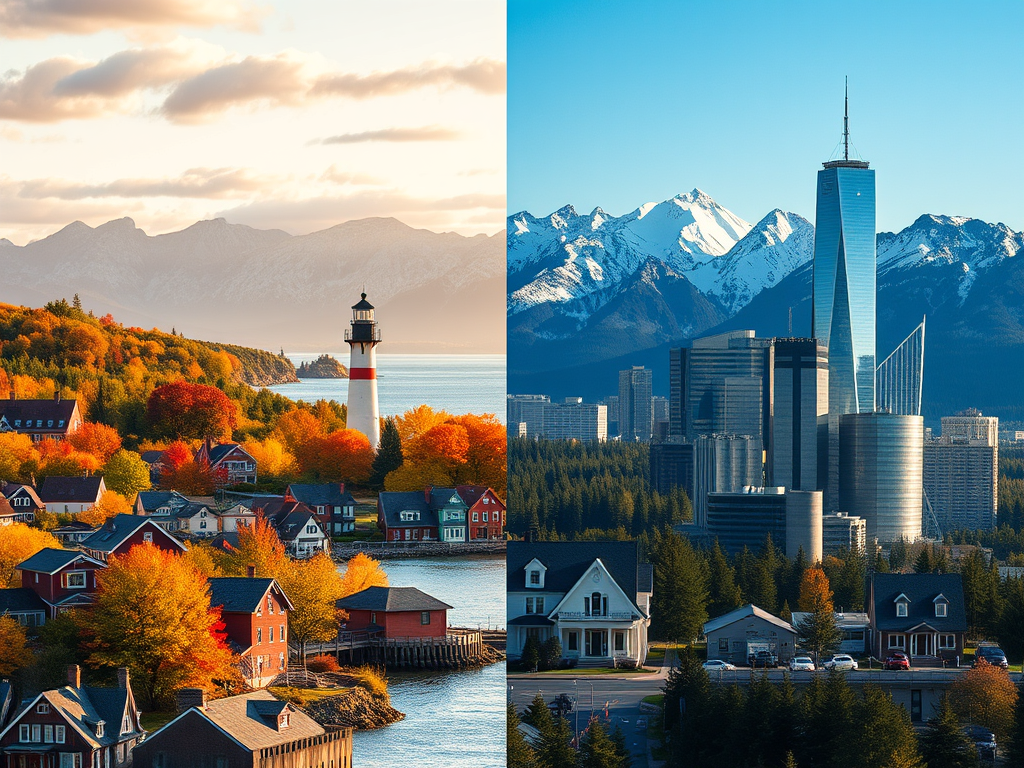
The Great Divide: Why Western Canada Feels Like a Different World
If you’ve ever hopped on a flight from Toronto to Vancouver or driven from Montreal to Calgary, you know the feeling. It’s not just the change in time zones; it’s a shift in the very soul of the country. Canada is massive, but the cultural and geographic “vibe shift” between the East and the West is one of the most fascinating aspects of the Great White North.
So, why does the West feel so distinct from the East? It comes down to a mix of deep history, literal mountains, and a different kind of “hustle.”
1. Geography as Destiny
In the East (Ontario, Quebec, and the Maritimes), the landscape is defined by the rolling hills of the Canadian Shield, ancient forests, and the proximity to the Atlantic. It feels settled, lush, and cozy.
In the West, the scale changes entirely. You have the infinite, “big sky” horizon of the Prairies meeting the jagged, intimidating peaks of the Rockies. This creates a different psychology:
- The East feels tucked in and historic.
- The West feels expansive and untamed.
The Pacific Northwest adds another layer—the damp, emerald rainforests of BC feel more like a scene from Jurassic Park than a typical Canadian winter wonderland.
2. The Weight of History vs. The “New Frontier”
The East is where Canada’s colonial roots are deepest. Cities like Quebec City and Halifax hold centuries of European influence, visible in the stone architecture and narrow streets. There’s a sense of “establishment” and tradition, particularly in the corridors of power in Ottawa and the financial hubs of Toronto.
The West, by comparison, still retains a bit of that “frontier spirit.” Many Western cities were established much later, fueled by the railway, the gold rush, and the oil boom. This has bred a culture of:
- Self-reliance: A “do-it-yourself” attitude born from being far from the capital.
- Risk-taking: A population often made up of people who moved West specifically to reinvent themselves or seek fortune.
3. Lifestyle: Suits vs. Spandex
While Toronto and Montreal are global hubs of fashion, finance, and high-speed urban life, the West tends to prioritize the outdoors as the primary status symbol.
| Feature | Eastern Canada (ON/QC) | Western Canada (BC/AB) |
| Pace of Life | Fast, career-oriented, “Big City” energy. | Balanced, wellness-focused, “Mountain” energy. |
| Fashion | Polished, urban, layers for humidity. | Functional, “Gorpcore,” flannel, and hiking boots. |
| Social Life | Centered around patios, bars, and culture. | Centered around the trailhead, the slopes, or the lake. |
In Vancouver, it’s perfectly normal to see someone in a boardroom wearing Lululemon; in Calgary, the “White Hat” hospitality and cowboy boots aren’t just for the Stampede—they’re a point of pride.
4. The Political and Economic Friction
We can’t talk about the difference without mentioning the “Western Alienation” trope. Because the majority of Canada’s population (and therefore political seats) is in the East, Westerners—particularly in Alberta and Saskatchewan—often feel their industries (like energy and agriculture) are misunderstood by the “Laurentian Elite.” This creates a gritty, rebellious streak in Western Canadian identity that you just don’t find in the suburbs of Oakville or Laval.
The Verdict
The East is the heart of Canada’s history and its gateway to the world; the West is the lungs of the country, where the air is thinner, the peaks are higher, and the rules feel a little more flexible. Whether you prefer the cobblestones of the East or the canyons of the West, the beauty of Canada lies in the fact that you can travel 4,000 kilometers and feel like you’ve discovered a brand-new country.
Leave a Reply