
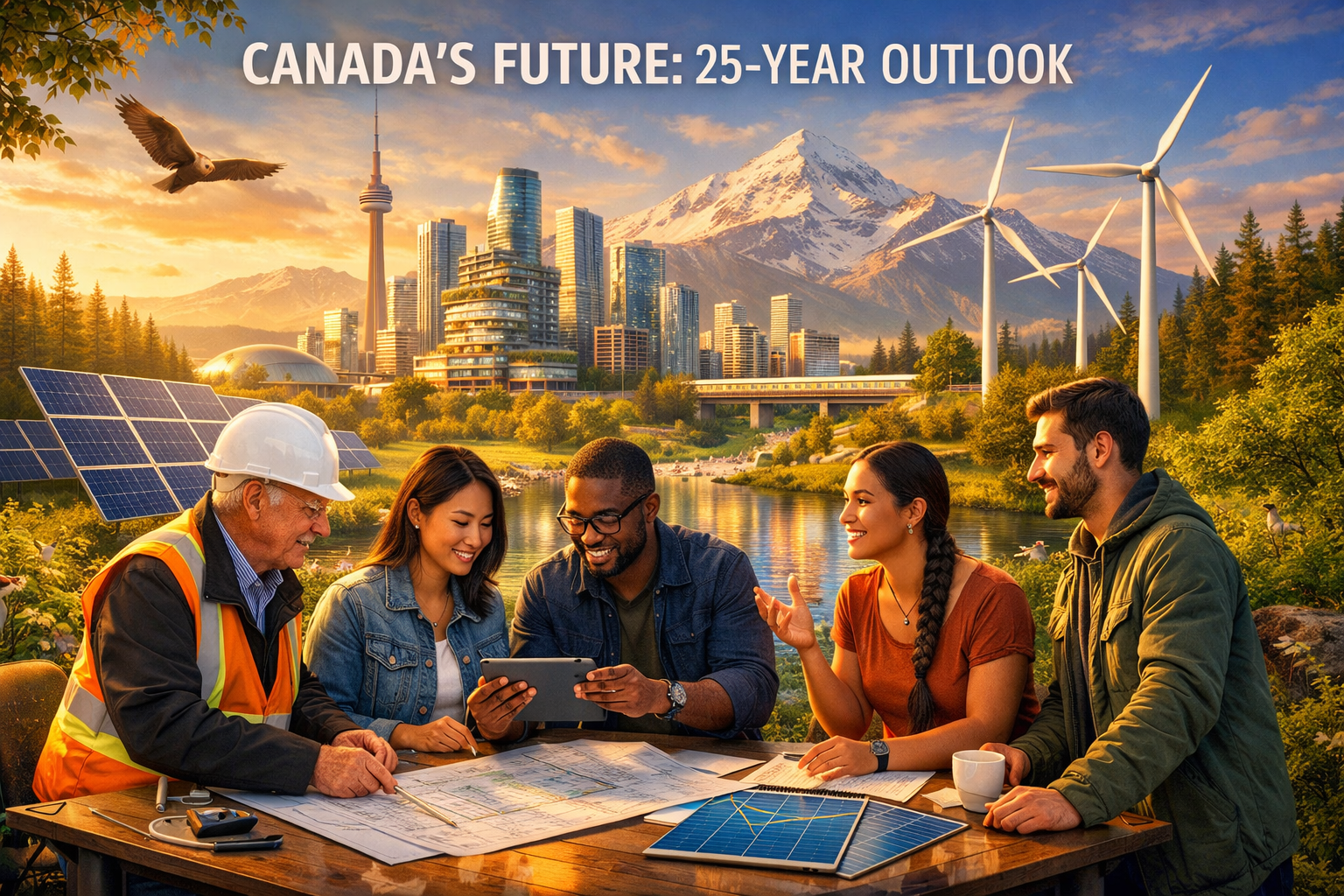
In 2026, Canada stands at a unique crossroads. The “post-pandemic” era has settled into a period of deep structural recalibration. As we look toward 2050—a quarter-century from now—the Canada of the future isn’t just a bigger version of today; it is a nation being fundamentally rewired by demographic shifts, a green industrial revolution, and a radical technological pivot.
Here is a roadmap of where the True North is headed over the next 25 years.
1. Demographics: The “Silver Peak” and the New Workforce
By 2050, Canada’s population is projected to reach between 45 and 52 million, but the shape of that population will look very different.
- Peak Aging (2026–2031): We are currently in the most intense phase of “population aging” as the final cohorts of Baby Boomers reach 65. Over the next decade, this will place unprecedented pressure on healthcare systems and labor supply.
- The Immigration Pivot: Having moved away from the record-high “surge” levels of 2023-2024, Canada has entered a “stabilization” phase. By the 2030s, expect a hyper-focus on economic immigration—specifically targeting healthcare professionals, green-tech engineers, and skilled trades to build the infrastructure of 2050.
- A “Super-Diverse” Nation: By 2050, roughly one in two Canadians will be an immigrant or the child of an immigrant. This diversity will be Canada’s “secret sauce” for global trade, especially as economic power shifts toward the Indo-Pacific.
2. The Net-Zero Industrial Revolution
The year 2050 isn’t just a random date—it’s the legal deadline for Net-Zero Emissions under the Canadian Net-Zero Emissions Accountability Act.
The Energy Transition
Canada is shifting from being a “resource exporter” to a “clean energy superpower.”
- The Grid: By 2050, Canada will need to double or triple its electricity capacity. This means a massive expansion of wind, solar, and “wild card” technologies like Small Modular Reactors (SMRs).
- Critical Minerals: Northern Ontario and Quebec are poised to become the “Silicon Valley of Mining,” providing the lithium, nickel, and graphite required for the global EV revolution.
Regional Shifts
While Ontario and B.C. remain tech hubs, Alberta and Saskatchewan are reinventing themselves. Expect these provinces to lead in Carbon Capture, Utilization, and Storage (CCUS) and hydrogen production, keeping them central to Canada’s GDP even as traditional oil demand fluctuates.
3. Housing and Urban Living: The “Missing Middle”
The housing crisis of the early 2020s has forced a permanent change in how Canadians live.
- The End of the “Bungalow Era”: Zoning laws in major cities like Toronto, Vancouver, and Calgary are already being dismantled. By 2050, the standard Canadian neighborhood will be defined by fourplexes, row houses, and low-rise apartments—the “missing middle.”
- The Rise of Secondary Hubs: High costs in the “Big Three” cities are pushing growth into mid-sized hubs like Edmonton, Halifax, and Kitchener-Waterloo, which will likely see some of the highest growth rates in the country over the next 25 years.
4. Technology: The AI-Driven Productivity Leap
For decades, Canada has struggled with low productivity. AI is the tool expected to finally fix this.
- Economic Impact: Generative AI is projected to add up to $180 billion annually to Canada’s economy by 2030. By 2050, it will be deeply embedded in every sector.
- Healthcare 2.0: With an aging population, AI-enabled diagnostics and wearable sensors will shift the focus from “sick care” to predictive health management, allowing seniors to live independently in their homes much longer.
- The Bio-Digital Divide: A key challenge for 2050 will be ensuring that the gains from automation don’t create a “two-tier” society. Expect ongoing debates about Universal Basic Income (UBI) or “participation incomes” to resurface as automation changes the nature of work.
The Verdict: A Nation of Resilience
The next 25 years will be defined by recalibration. Canada is moving from a period of “growth at any cost” to a period of “strategic sustainability.” The path will be bumpy—marked by trade tensions and climate adaptation—but the underlying fundamentals suggest a country that is younger, more diverse, and more technologically integrated than almost any of its G7 peers.
Perspective: In 2050, Canada won’t just be a middle power; it will be a crucial “linchpin” state—a bridge between the U.S. and the rest of the world, fueled by green energy and a highly skilled, globalized workforce.
Leave a Reply