
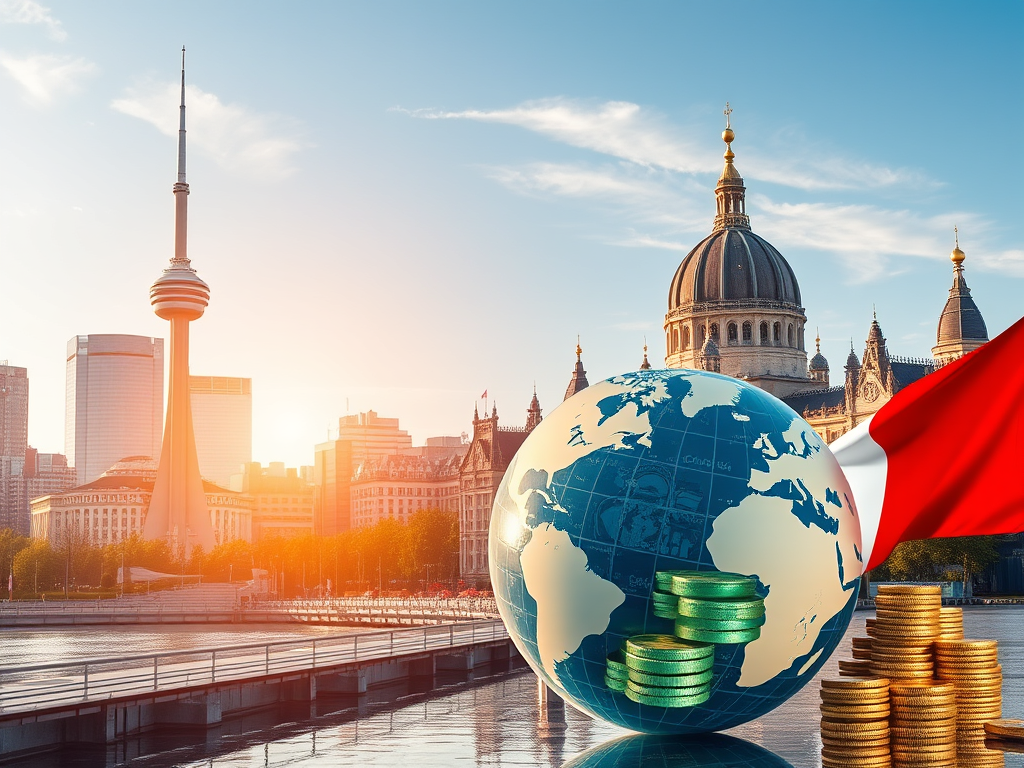
As we navigate the mid-2020s, the phrase “New World Order” has transitioned from geopolitical theory to economic reality. For Canada, a nation historically defined by its proximity to the United States and its vast natural resources, 2026 marks a pivotal “reboot.”
This is no longer just about being a “branch plant” economy. Canada is positioning itself as a critical node in a fragmented, security-focused global marketplace. Here is a detailed look at Canada’s strategic role in this new era.
1. The “Friend-Shoring” Powerhouse
In the wake of the 2025 trade shocks and the U.S. Supreme Court’s striking down of broad tariffs, Canada has emerged as the premier “trusted partner.” While global supply chains were once built on efficiency, they are now built on resilience.
- The CUSMA Advantage: Canada enters 2026 with a structural edge—one of the lowest effective tariff rates with the U.S. While the July 2026 CUSMA Joint Review looms, Canada has leveraged its stability to capture trade shares that were previously held by more volatile overseas markets.
- Strategic Autonomy: Under the new “Defence Industrial Strategy” (Feb 2026), Canada is pivoting its manufacturing base—specifically steel and aluminum—to support allied defense needs, moving from general exports to security-linked production.
2. The Critical Minerals Sovereign
The “New World Order” runs on batteries and semiconductors. Canada is no longer content to simply mine raw materials; it is moving up the value chain to become a processing hub.
| Initiative | Investment | Focus |
| Critical Minerals Sovereign Fund | $2.0 Billion | Strategic equity and loan guarantees for fast-tracking projects. |
| First and Last Mile Fund | $1.5 Billion | Mining infrastructure: roads, transmission, and Indigenous-led routes. |
| Project Navigator | Regulatory | Shifting to a “One Project, One Review” system with 2-year targets. |
By March 2026, Canada has secured over $18.5 billion in critical mineral partnerships through the G7 Alliance, ensuring that the lithium, nickel, and copper powering the global energy transition are “sourced in Canada.”
3. The Energy Transition: A “Timbit” a Barrel
The debate over carbon pricing has reached a pragmatic truce in 2026. With the Canada-Alberta MOU, the focus has shifted toward industrial carbon pricing as a tool for global competitiveness rather than just a domestic tax.
- Carbon Border Adjustments: As Japan and Europe implement carbon tariffs, Canada’s clean-tech investments ensure its exports remain “carbon-competitive.”
- Minimal Cost Impact: Research from the Canadian Climate Institute shows that even with carbon prices rising toward $130/tonne, the net cost to oil sands producers is less than $0.50 per barrel (or roughly the price of a Timbit).
- West Coast Diversification: A key 2026 milestone includes the application for additional West Coast pipeline capacity to reduce reliance on the U.S. market and feed Asian demand.
4. Sovereign AI and Digital Infrastructure
2026 is the year of Sovereign AI. Moving beyond “AI pilots,” the Canadian government has launched a renewed National AI Strategy to protect domestic intellectual property and build “sovereign compute” infrastructure.
“Canada must scale domestic champions to prevent foreign dominance and ensure our critical AI operations remain domestic.” — Summary of Inputs, Canada’s Next AI Strategy (Feb 2026)
The focus has shifted from general research to applied AI in sectors where Canada leads: precision medicine, smart mining, and climate solutions. A recent $552 million investment via the Canada Foundation for Innovation is currently equipping 92 research hubs to bridge the gap between lab and market.
The “New Global Economy” is grappling with aging populations. Canada is undergoing a structural transition in its labor market:
- Labor Market Reset: Following 2025’s immigration recalibrations, population growth in Ontario and B.C. has actually turned negative.
- Productivity Push: With fewer “new” workers, the economic mandate has shifted toward labor productivity—using AI and automation to maintain GDP growth even as the final baby boomer cohorts reach retirement age (65).
The Verdict
Canada’s role in the New World Order is that of a Reliable Provider. It is the safe harbor for capital, the ethical source for minerals, and the high-tech ally for defense. While trade tensions with the U.S. remain a constant background hum, the “reboot” of 2026 suggests a country finally finding its footing in a more fractured, but more purposeful, global economy.
Leave a Reply