
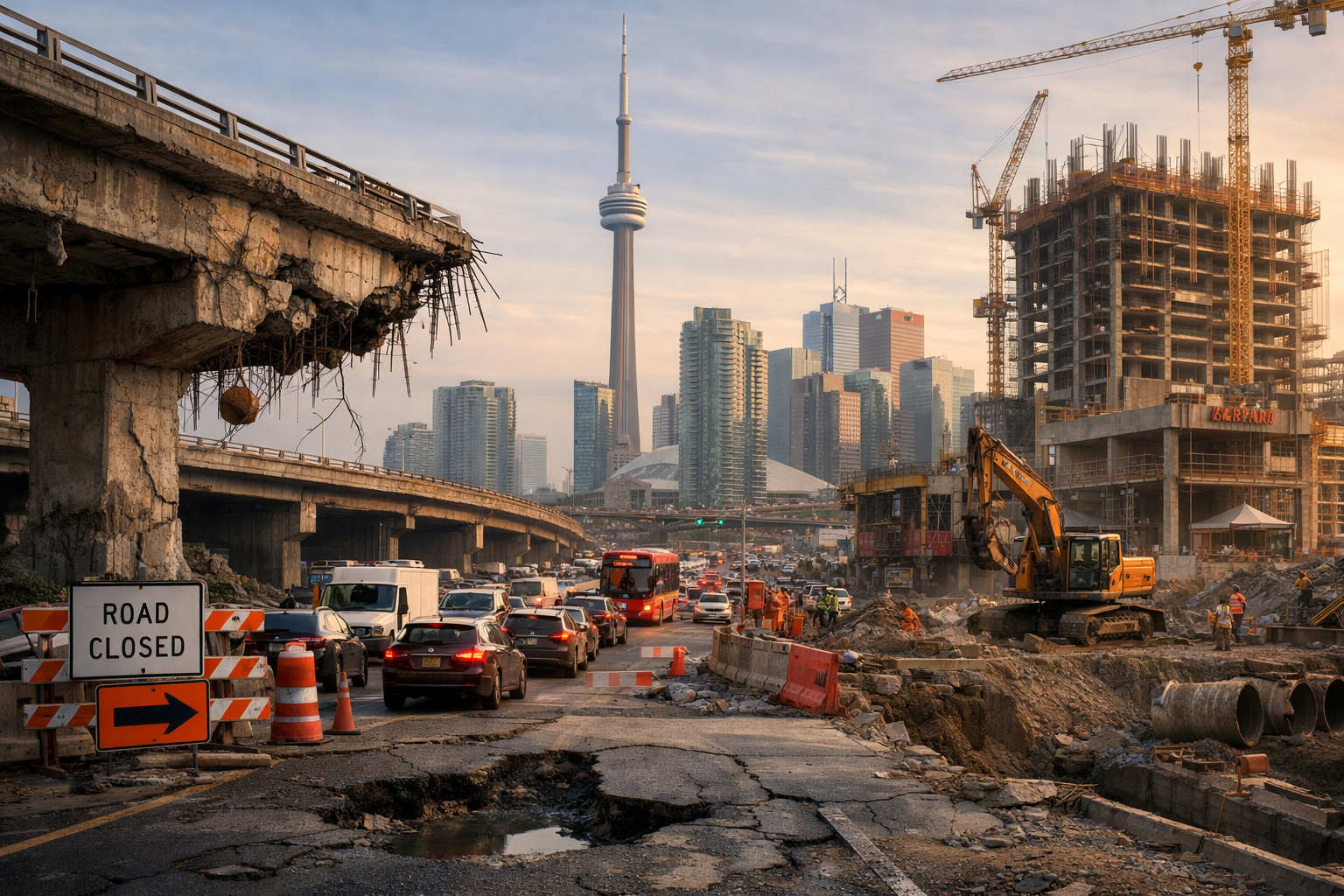
In 2026, Canada stands at a critical infrastructure crossroads. While the nation has historically been defined by its “nation-building” projects—from the Canadian Pacific Railway to the Trans-Canada Highway—the current landscape is defined by a different reality: a staggering $270 billion national infrastructure deficit.
As we look at the state of the country this year, the challenge has shifted from simply “building more” to a complex puzzle of housing-enabling utilities, climate resilience, and a “delivery capacity crisis.”
1. The “Invisible” Crisis: Housing-Enabling Infrastructure
The most pressing challenge in 2026 isn’t just the lack of rooftops, but what lies beneath them. According to the National Infrastructure Assessment (NIA) released late last year, the path to solving Canada’s housing crisis is blocked by aging water, wastewater, and solid waste systems.
- The Servicing Ceiling: In many high-growth regions, such as Ontario’s GTHA, housing projects are sitting “shovel-ready” but stalled because local water treatment plants and sewer systems are at maximum capacity.
- The Cost of Inaction: Over $126 billion in housing-enabling infrastructure is currently classified in “poor” or “very poor” condition. Without immediate renewal, these systems risk failure, making new housing starts mathematically impossible in many municipalities.
2. The Delivery Capacity Crisis
For years, the conversation was about “funding gaps.” In 2026, the narrative has evolved. Even with the federal government’s $115 billion generational investment through the Building Communities Strong Fund, Canada is hitting a physical limit on how much it can actually build.
Labor and Material Constraints
The construction industry is projected to need over 380,000 new workers by 2034. In the short term, the shortage of skilled trades is driving up project costs and extending timelines.
- Inflationary Pressures: While some material costs have stabilized, “aggregate-derived products” (sand, gravel, and stone) are becoming economically scarce, further squeezing the budgets of municipal road and bridge projects.
- Regulatory Fragmentation: A major bottleneck remains the lack of standardized municipal construction specifications. Moving a project from approval to construction is often delayed by a “patchwork quilt” of local rules.
3. Climate Resilience: The $10 Billion Opportunity
Climate change is no longer a “future risk” for Canadian engineers; it is a daily operating reality. From permafrost thaw in the North to extreme flooding in the Prairies, our assets are being tested.
The Adaptation Math: Recent data from the Canadian Climate Institute suggests that investing $3 billion per year in proactive adaptation (like resilient storm sewers and heat-resistant pavements) could save taxpayers $10 billion annually in avoided damages.
4. The New Frontier: Digital and Northern Sovereignty
In 2026, the definition of “infrastructure” has expanded.
- Digital Power: There is a massive surge in demand for digital infrastructure, with over 18,000 MW of new data center grid connection requests in Ontario and Alberta alone. This is placing unprecedented pressure on the national energy grid.
- The Arctic Corridor: Prime Minister Carney’s recently announced Arctic Infrastructure Fund signals a shift toward “dual-use” infrastructure—all-season roads and deepwater ports that serve both Indigenous communities and national defense.
The Path Forward: 2026 and Beyond
The era of “performative planning” is over. To bridge the deficit, Canada is moving toward:
- Asset Management: Prioritizing the maintenance of existing structures over the “ribbon-cutting” of new ones.
- Densification: Building “up rather than out” to maximize the efficiency of existing pipes and transit lines.
- Innovative Financing: Leveraging private capital and pension funds to supplement the federal deficit.
Canada’s infrastructure is the “silent partner” in our economy. As we move through 2026, the success of our housing markets and our climate goals depends entirely on how quickly we can modernize this aging foundation.
Leave a Reply