
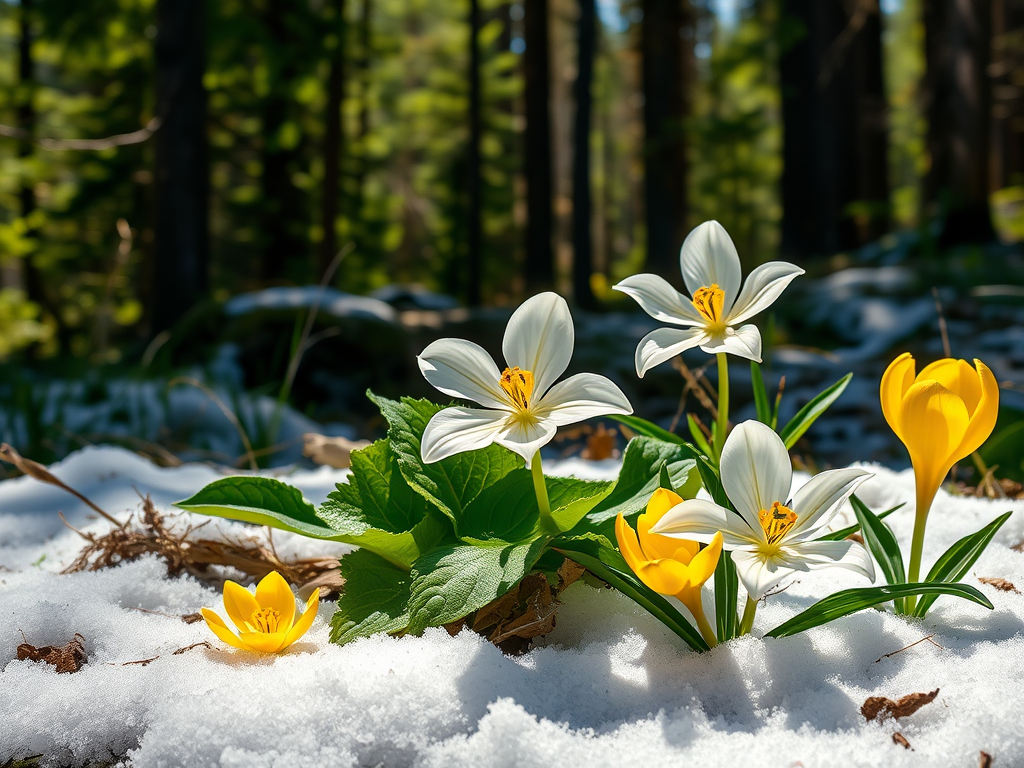
Awakening the Tundra and Timber: A Guide to Canada’s Spring Ephemerals
As the snow retreats from the rugged Rockies to the coastal cliffs of Newfoundland, Canada undergoes a quiet, colorful transformation. After months of monochromatic whites and greys, the arrival of indigenous spring wildflowers is more than just a seasonal shift—it is a biological marathon.
These “spring ephemerals” have a fleeting window to bloom, pollinate, and store energy before the forest canopy closes and steals their sunlight. Here is a deep dive into the resilient beauties that define the Canadian spring.
1. The White Trillium (Trillium grandiflorum)
Region: Primarily Ontario and Quebec.
The undisputed celebrity of the Canadian spring, the White Trillium is Ontario’s provincial floral emblem. It is a true ephemeral, often found in deciduous forests where the soil is rich and moist.
- The Signature Look: It features three waxy white petals, three green sepals, and three leaves. As the flower ages, the petals often fade to a soft, dusty pink.
- The Lifecycle: Trilliums are notoriously slow growers. It can take up to 7 to 10 years for a single plant to produce its first flower.
- Conservation Note: While it’s a myth that picking one is “illegal” in all contexts, doing so can kill the plant or prevent it from flowering for years, as the leaves are its only source of energy.
2. Prairie Crocus (Pulsatilla nuttalliana)
Region: The Prairies (Manitoba, Saskatchewan, Alberta).
While not a true crocus (it’s actually part of the buttercup family), this is usually the first sign of life on the Canadian plains, often poking through the lingering snow in late March or April.
- Adaptation: The entire plant is covered in fine, silky hairs. This isn’t just for looks—these hairs act like a fur coat, insulating the plant against the harsh, biting winds of the Prairies.
- Symbolism: It is the provincial flower of Manitoba and represents resilience and the end of the long prairie winter.
3. Western Skunk Cabbage (Lysichiton americanus)
Region: British Columbia.
If you find yourself in the temperate rainforests of the Pacific Northwest, you’ll likely smell this flower before you see it.
- The “Stink”: It produces a skunk-like odor to attract its primary pollinators: flies and beetles.
- Thermogenesis: Remarkably, this plant can generate its own heat (up to 15°C to 20°C above the ambient air temperature), allowing it to melt its way through frozen ground or thin ice.
- Visuals: It features a large, bright yellow “spathe” (a leaf-like hood) surrounding a central spike called a spadix.
4. Bloodroot (Sanguinaria canadensis)
Region: Eastern Canada (Nova Scotia to Manitoba).
Bloodroot is a master of the “one-day show.” Each flower typically lasts only a day or two, making a sighting a lucky event for hikers.
- The Name: The plant produces a bright orange-red sap in its rhizomes (roots) that resembles blood. Indigenous peoples historically used this sap as a potent dye for baskets, clothing, and face paint.
- The Leaf: The flower emerges wrapped in a single, deeply lobed grey-green leaf, which unfurls as the bloom opens.
5. Calypso Orchid (Calypso bulbosa)
Region: Found across Canada in cool, mossy coniferous forests.
Also known as the Fairy Slipper, this is one of Canada’s most delicate and enchanting wild orchids.
- The Deception: The Calypso orchid is a “deceptive pollinator.” It looks and smells like it’s full of nectar to attract bumblebees, but it actually provides no reward. The bees eventually learn to avoid them, so the orchid relies on young, inexperienced bees for pollination.
- Sensitivity: These are incredibly fragile. Their root systems are shallow and intertwined with specific fungi in the soil; even stepping near them can compact the soil enough to kill the plant.
Tips for Spring Flower Spotting in Canada
If you’re heading out to witness this botanical revival, keep these “Pro-Tips” in mind to ensure these plants thrive for another generation:
| Tip | Why it Matters |
| Stay on the Path | Many spring flowers (like the Calypso Orchid) have shallow roots that are easily crushed. |
| Check the “Duff” | Many flowers, like Wild Ginger or Dutchman’s Breeches, bloom very low to the ground under leaf litter. |
| Bring a Macro Lens | Canadian wildflowers are often small and intricate; a zoom or macro lens captures the detail without you needing to step off-trail. |
| Watch the Weather | Many species, such as Bloodroot and Spring Beauty, close their petals on cloudy days to protect their pollen. |
The Canadian spring is a race against time. Whether it’s the heat-generating Skunk Cabbage of the West or the slow-growing Trillium of the East, these indigenous blooms are a testament to the incredible grit of the northern wilderness. Happy hiking!
Leave a Reply