
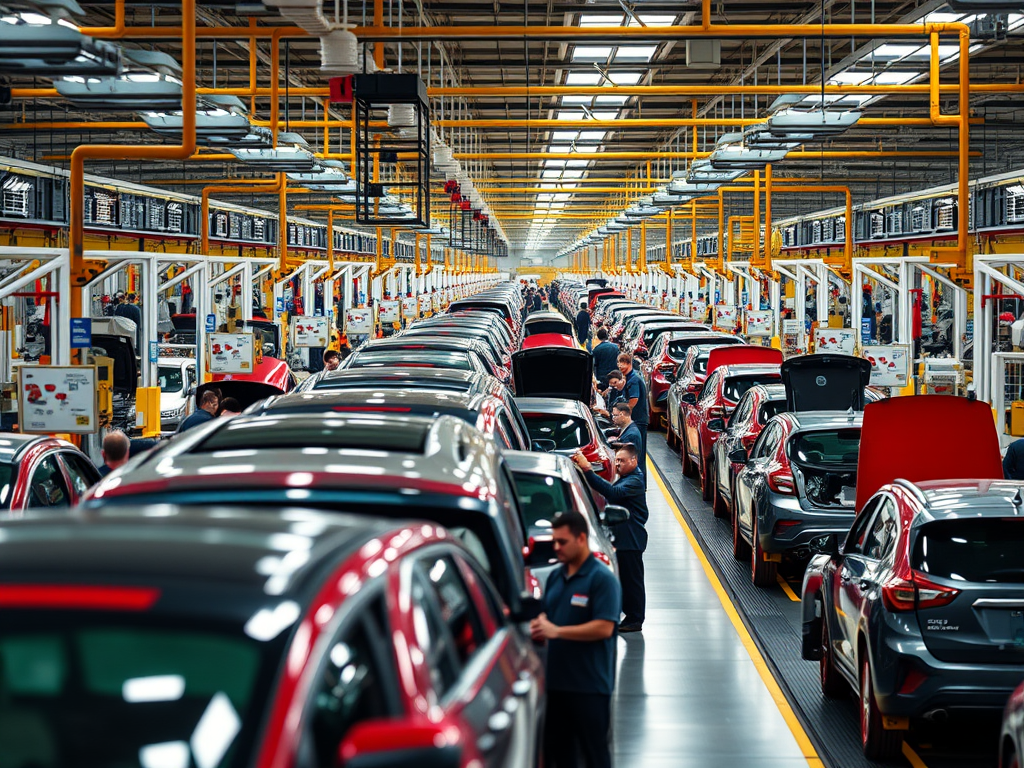
Building a vehicle in Canada for export to the U.S. is a question of balancing lower operational costs against trade compliance risks. For a manufacturer, the decision isn’t just about where the assembly line sits, but where the entire value chain—from steel to software—is sourced.
The short answer is: It is highly beneficial only if the manufacturer can strictly adhere to USMCA (CUSMA) rules. If they fall outside these rules, shipping a completed vehicle becomes significantly more expensive than building it in the U.S.
The Cost Advantage (The “Why Build in Canada” Side)
Canada offers several structural advantages that make it an attractive “factory floor” for the U.S. market:
- Labor and Healthcare Costs: In Canada, universal healthcare is publicly funded, which significantly lowers the per-employee benefit costs for manufacturers compared to the U.S. Estimates suggest a 31% labor cost advantage for Canadian auto parts operations.
- Currency Exchange: A weaker Canadian Dollar (CAD) often makes Canadian exports more competitive. Manufacturers pay for labor and local parts in CAD but sell the finished vehicle in USD.
- Plant Quality: Canadian plants historically win a disproportionate number of quality awards (like J.D. Power). For a manufacturer, “Made in Canada” often correlates with lower warranty costs and better reliability.
The Trade Barrier (The “Why It’s Risky” Side)
The USMCA (United States-Mexico-Canada Agreement) set very high bars for what counts as a “North American” car. To ship a vehicle from Canada to the U.S. duty-free, it must meet these “Rules of Origin”:
| Requirement | Description |
| Regional Value Content (RVC) | 75% of the vehicle’s value must come from North America (up from 62.5% under NAFTA). |
| Labor Value Content | 40–45% of the work must be done by workers earning at least $16 USD/hour. |
| Steel & Aluminum | 70% of the metals used must be sourced from North America. |
| Core Parts | Engines, transmissions, and batteries must be originating (built in NA). |
The Risk: If a manufacturer builds a vehicle in Canada but uses too many overseas parts (e.g., a battery from China or an engine from Europe), they may fail these tests. At that point, the U.S. can slap a 2.5% tariff on cars or a massive 25% “Chicken Tax” on light trucks/vans.
Logistical Realities
The automotive industry operates on a “Just-in-Time” (JIT) model. Parts often cross the border 7 to 8 times before the vehicle is finished.
- Proximity: For plants in the Windsor-Detroit corridor, shipping a completed vehicle across the bridge is effectively the same as shipping it across a state line.
- Specialization: Most plants only build 1 or 2 specific models. It is more efficient for a manufacturer to build all of a specific SUV model in Ontario for the entire North American market than to split production between two countries.
Summary of Benefits vs. Drawbacks
| Beneficial If… | Not Beneficial If… |
| The vehicle meets the 75% RVC requirement. | The supply chain relies heavily on non-NA parts. |
| The CAD is weak against the USD. | There are threats of “blanket tariffs” (e.g., 25% proposals). |
| The model is high-complexity (leveraging skilled labor). | The vehicle is a light truck (subject to 25% duty if non-compliant). |
Building heavy trucks in Canada for the U.S. market has become a high-stakes strategy in 2026. While the fundamental “Auto Pact” integrated the two markets decades ago, recent 2025/2026 trade policy shifts have made compliance the difference between a profitable venture and a 25%–35% loss.
As a 310T technician, you likely see the physical reality of this: parts like Cummins engines or Daimler ECUs often come from global supply chains, but where they are bolted onto the frame rail now dictates the entire price of the truck.
The Heavy Truck “Rule of Origin”
For Class 7 and 8 trucks, the rules are slightly different than for passenger cars. To ship a heavy truck from Canada to the U.S. duty-free today:
- Regional Value Content (RVC): At least 64% of the truck’s value must be North American (this is scheduled to jump to 70% on July 1, 2027).
- Labor Value Content (LVC): At least 30% of the truck’s net cost must come from high-wage labor (avg. $16 USD/hr). Canada easily meets this, making it a “safe” zone for this requirement.
- Steel/Aluminum: 70% of the metal must be North American.
The 2026 “Tariff Wall”
As of late 2025 and into 2026, the U.S. has implemented aggressive Section 232 and IEEPA tariffs that specifically target heavy-duty vehicles (MHDVs).
| Scenario | U.S. Import Duty Rate |
| USMCA Compliant | 0% (though you may pay 25% only on the value of non-U.S. parts like a European engine). |
| Non-Compliant | 25% to 35% on the entire value of the truck. |
| The “Transshipment” Trap | 40% if the U.S. suspects a truck was built elsewhere and “passed through” Canada to evade duties. |
Technician’s Perspective: This means manufacturers are now hyper-focused on “Core Parts.” If a truck is built in Canada but uses a transmission or axle set from outside North America, it risks losing its duty-free status entirely.
Why Manufacturers Still Build in Canada
Despite the trade war climate, Canada remains beneficial for heavy trucks (like PACCAR/Kenworth in Quebec or Hino and Lion Electric in Ontario/Quebec) for three reasons:
The “U.S. Content” Credit
A unique rule allows Canadian-built trucks to pay 25% duty only on the non-U.S. content. * Example: If a truck built in Quebec is 60% U.S. parts and 40% non-U.S. parts, the manufacturer only pays the 25% tariff on that 40% slice. A truck built in a non-USMCA country would pay 25% on the entire $200,000+ sticker price.
Vocational Specialization
Canada has a massive “vocational” market (logging, mining, oil/gas). Manufacturers often find it more beneficial to build heavy-spec, specialized chassis in Canada because the local labor force (technicians like you) understands the “extreme duty” requirements better than general assembly lines in the Southern U.S.
The Offset Program
The U.S. introduced a 3.75% offset for trucks assembled in North America. This helps manufacturers recover some of the costs paid on imported parts (like specialized sensors or emissions components) as long as the final “marriage” of the chassis happens here.
Summary: Benefit vs. Risk
- The Benefit: Lower labor/benefit costs and a highly skilled technical workforce in Ontario/Quebec.
- The Risk: A single paperwork error or a “non-originating” transmission can trigger a $50,000+ tariff per truck at the border.
 Canadian Country Life