
History
Accomplishments
Symbols
History of Canada
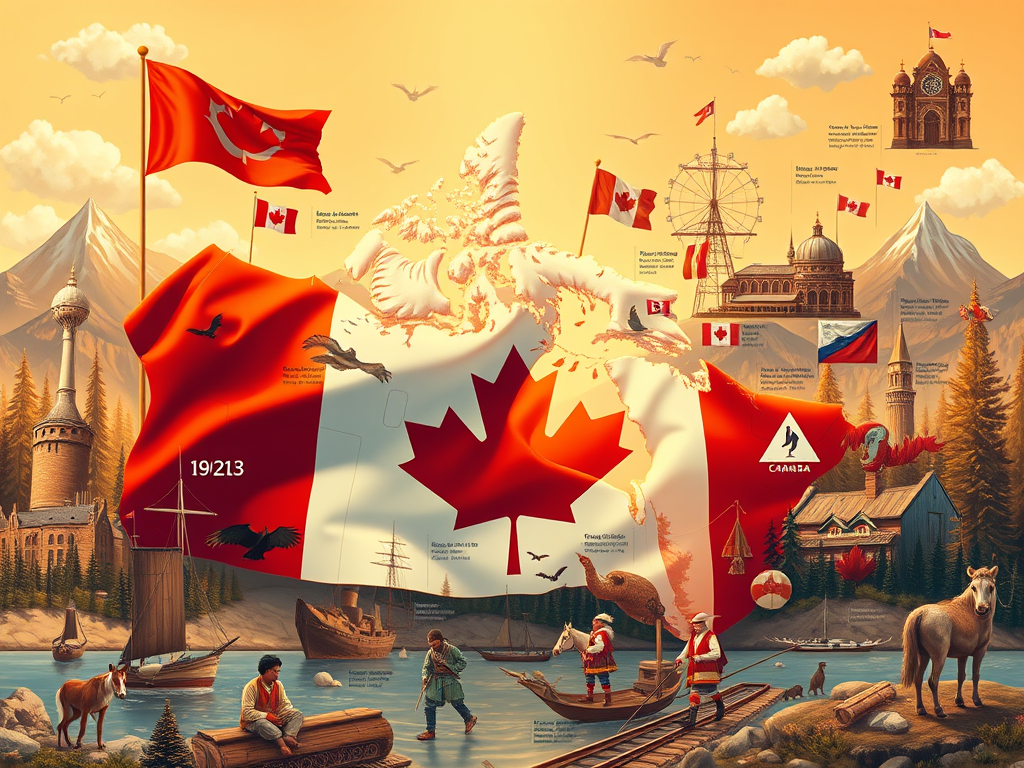
Pre-ColonizationIndigenous peoples, including First Nations, Inuit, and Métis, lived on and cared for the land for thousands of years with complex social, political, and cultural systems.
1867: ConfederationOn July 1st, the British North America Act created the Dominion of Canada, uniting Ontario, Quebec, Nova Scotia, and New Brunswick.
1885: Transcontinental RailwayThe Canadian Pacific Railway was completed, physically connecting the Atlantic to the Pacific and enabling the expansion of the West.
1914-1918: WWI & Vimy RidgeCanada’s contributions to the Great War, particularly the victory at Vimy Ridge, are often cited as the moment Canada truly became a nation in its own right.
1982: Patriation of the ConstitutionThe Constitution Act was signed, including the Charter of Rights and Freedoms, giving Canada full control over its own laws and sovereignty.
Great Canadian Accomplishments
Medicine: Insulin
In 1921, Frederick Banting and Charles Best discovered insulin at the University of Toronto, saving millions of lives of people with diabetes.
Space: The Canadarm
A marvel of robotic engineering, the Canadarm supported NASA’s Space Shuttle missions for 30 years and remains a symbol of Canadian innovation.
Peacekeeping
Lester B. Pearson won the Nobel Peace Prize for creating the first modern UN peacekeeping force to resolve the Suez Crisis in 1956.
Telecommunications
Alexander Graham Bell did much of his foundational work in Brantford, Ontario, leading to the invention of the telephone.
The Hidden Gems
| Province/Territory | Hidden Gem Location | Why Visit? |
| Ontario | Manitoulin Island | The world’s largest freshwater island; incredible for rugged shoreline photography and Indigenous culture. |
| Quebec | Île d’Orléans | A “living museum” of traditional French-Canadian rural life just outside Quebec City. |
| British Columbia | Haida Gwaii | Known as the “Galapagos of the North,” offering ancient totem poles and moss-covered rainforests. |
| Alberta | Waterton Lakes | Where the prairies meet the peaks; less crowded than Banff but equally stunning. |
| Saskatchewan | Cypress Hills | The highest point between the Rockies and Labrador; an “island” of forest in the plains. |
| Manitoba | Whiteshell Provincial Park | Features ancient Aboriginal petroforms (rock alignments) and the beautiful Canadian Shield. |
| Nova Scotia | Lunenburg | A UNESCO World Heritage site known for its brightly colored 18th-century wooden architecture. |
| New Brunswick | Alma & Fundy Park | Home to the world’s highest tides; the “Flowerpot Rocks” are a photographer’s dream. |
| PEI | Victoria-by-the-Sea | A tiny, picturesque fishing village that captures the essence of island life. |
| Newfoundland | Trinity | One of the oldest and most preserved villages in North America; perfect for iceberg and whale spotting. |
| The North | Dawson City, Yukon | A preserved Gold Rush town that feels like stepping back into 1898. |
National Symbols
- The Maple Leaf: Featured on the national flag since 1965.
- The Beaver: Recognized as an official symbol of Canada in 1975 for its role in the historic fur trade.
- The Maple Tree: Canada’s official arboreal emblem.