
The Great White North: Deciphering the Mysteries of Canada
Canada is a land of massive proportions and even bigger contradictions. It is the second-largest country on Earth, yet it possesses a population smaller than the state of California. It is home to breathtaking natural beauty and staggering costs of living.
If you’ve ever looked at a map and wondered about the mechanics behind this northern giant, you aren’t alone. Let’s dive into the five biggest questions that define the Canadian experience.
1. Why is Canada so cold?
The short answer is latitude and geography. Because Canada stretches from the 42nd parallel all the way to the North Pole, much of its landmass sits in the subarctic and arctic zones.
- The Angle of the Sun: Due to the Earth’s tilt, northern latitudes receive solar radiation at a more oblique angle. This means the sun’s energy is spread over a larger area and must travel through more of the atmosphere, losing heat along the way.
- The Continental Effect: Unlike Europe, which is warmed by the Gulf Stream, much of Canada’s interior (the Prairies) is far from any moderating ocean influences. Without water to store heat, the land cools down rapidly in the winter.
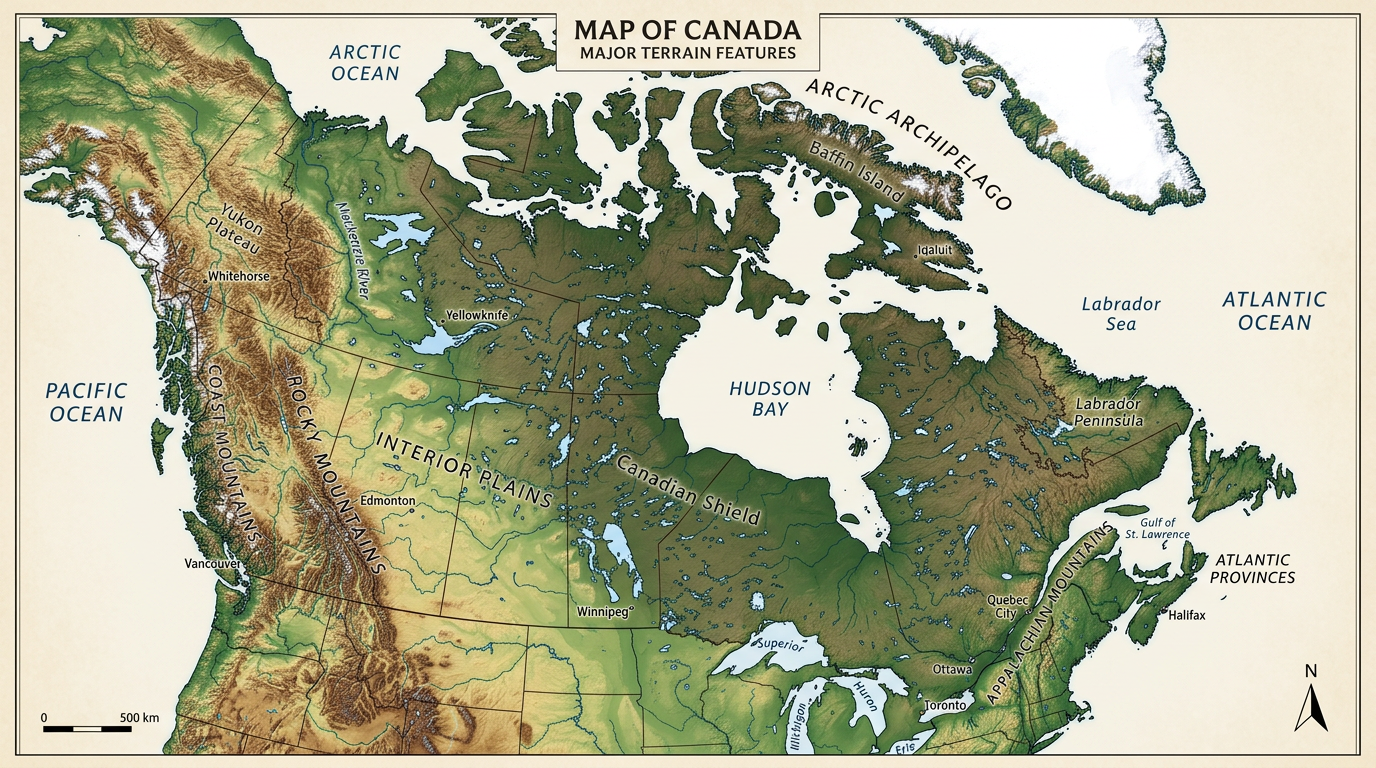
- Arctic High Pressure: Canada acts as a highway for the Polar Vortex. Cold, dense air from the Arctic frequently pushes south, meeting little resistance from the flat geography of the Canadian Shield.
2. Why is Canada so expensive to live in?
If you feel your wallet thinning in Vancouver or Toronto, you aren’t imagining it. Canada consistently ranks as one of the most expensive G7 nations.
- The Housing Crisis: A cocktail of low supply, high immigration-driven demand, and historically low interest rates (until recently) sent real estate prices soaring. In major hubs, housing costs often exceed 50% of a household’s take-home pay.
- Lack of Competition: Many Canadian industries are “Oligopolies”—controlled by a few giant firms. Whether it’s groceries (Loblaws, Sobeys), telecommunications (Rogers, Bell, Telus), or banking, less competition leads to some of the highest cell phone and food bills in the developed world.
- Logistics and Geography: Shipping goods across the world’s second-largest country is incredibly pricey. When you add “carbon taxes” and high fuel costs to those long distances, the price of a head of lettuce in the North can become astronomical.
3. Why does Canada have so much fresh water?
Canada contains roughly 20% of the world’s total freshwater resources. The reason for this “liquid gold” is largely historical and geological.
- The Last Ice Age: About 20,000 years ago, almost all of Canada was covered by the Laurentide Ice Sheet. As these massive glaciers retreated, they carved deep gouges into the bedrock.
- The Canadian Shield: The country’s core is made of ancient, hard igneous rock that doesn’t absorb water easily. When the glaciers melted, the water filled these rocky depressions, creating millions of lakes.
- Low Evaporation: Because of the cold climate mentioned earlier, the water that collects in these basins doesn’t evaporate as quickly as it would in tropical climates.
4. Why does Canada have so few people?
With nearly 10 million square kilometers of land, you’d expect more than 40 million people. However, Canada’s “emptiness” is a matter of habitability.
- The 100-Mile Rule: Roughly 90% of Canadians live within 100 miles (160 km) of the U.S. border.
- Unfriendly Terrain: Vast swaths of the country are comprised of the Canadian Shield (rocky, acidic soil unfit for farming) or permafrost. You can’t build massive cities easily on land where the ground is frozen or made of solid granite.
- Late Start and Climate: Unlike the U.S., which had a longer history of high-density agricultural settlement, Canada’s expansion was limited by the short growing seasons of the North.
5. What makes Canada unique?
Beyond the stereotypes of maple syrup and hockey, Canada’s uniqueness lies in its institutional and cultural fabric.
- The “Vertical Mosaic”: Unlike the American “Melting Pot,” Canada promotes a “Mosaic” where different cultures are encouraged to maintain their distinct identities while remaining Canadian.
- Dual Legal and Linguistic Heritage: It is one of the few nations to successfully operate with two official languages (English and French) and two legal systems (Civil Law in Quebec and Common Law elsewhere).
- Institutional Stability: Canada is a Constitutional Monarchy. This blend of British parliamentary tradition and North American federalism has created one of the most stable, peaceful, and least corrupt societies in human history.
“Canada is the only country in the world that knows how to live without an identity.” — Marshall McLuhan
While the cold may bite and the rent may sting, the combination of vast natural wealth and a deeply stable social contract makes Canada a truly singular place on the global stage.
Leave a Reply